
Calorie Calculator
4-in-1 — BMR · TDEE · Calorie Deficit (Lose Weight) · Calorie Surplus (Gain Weight)

Free TDEE, BMR & BMI Calculator Online
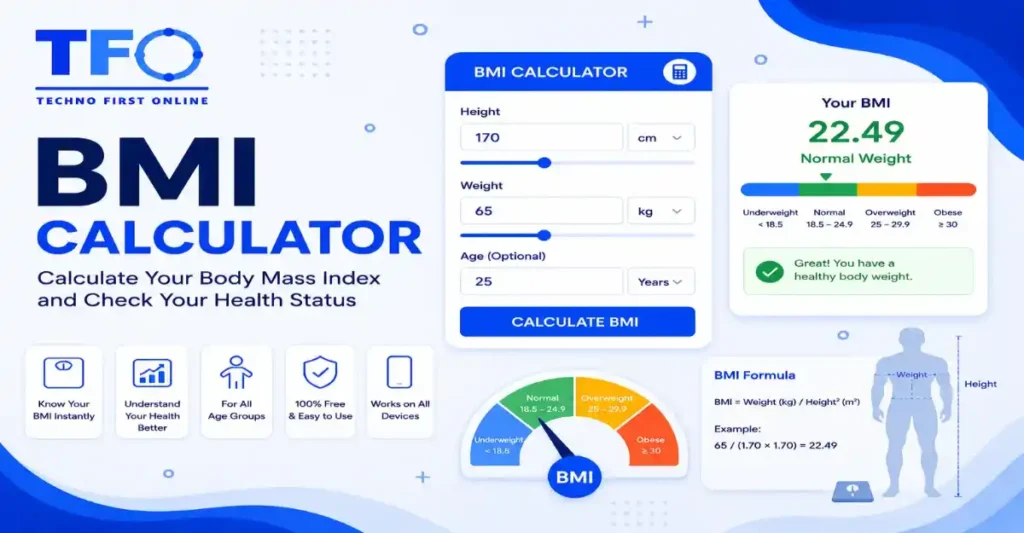
Calculate Your Ideal Weight, Calories & Fitness Goals
What Is BMI?
Understanding Body Mass Index
Maintaining a healthy body weight is one of the most important aspects of overall health and wellness. Whether your goal is weight loss, muscle gain, or simply understanding your current fitness level, knowing your Body Mass Index (BMI) is often the first step.
A BMI Calculator helps determine whether your weight falls within a healthy range based on your height and weight. It is one of the most widely used screening tools by healthcare professionals, fitness coaches, and individuals who want to monitor their health.
BMI does not directly measure body fat percentage, but it provides a useful estimate of whether you are underweight, normal weight, overweight, or obese.
This BMI, BMR & TDEE Calculator goes beyond a standard BMI calculator by helping you calculate your calorie requirements, maintenance calories, calorie deficit, and calorie surplus for weight management goals.
What Is BMI (Body Mass Index)?
Body Mass Index, commonly known as BMI, is a numerical value calculated using your height and weight. It is used to categorize individuals into different weight ranges and identify potential health risks associated with being underweight or overweight.
BMI is a simple and effective screening method that can help determine whether your current body weight is appropriate for your height.
Healthcare organizations around the world use BMI as a standard measurement because it is quick, easy, and requires only basic information.
Why Is BMI Important?
BMI can help identify potential health risks associated with excess body weight or insufficient body weight.
People with higher BMI values may have an increased risk of:
- High blood pressure
- Type 2 diabetes
- Heart disease
- Stroke
- Sleep apnea
- Joint problems
- Certain cancers
People with lower BMI values may experience:
- Nutritional deficiencies
- Weakened immune system
- Osteoporosis
- Reduced muscle mass
- Fertility issues
Although BMI is not a perfect measurement, it provides an excellent starting point for assessing overall health.
BMI Formula Explained
The BMI formula is straightforward and widely accepted worldwide.
For metric measurements:
BMI=\frac{Weight,(kg)}{Height,(m)^2}
Example BMI Calculation
Suppose a person weighs 70 kilograms and has a height of 1.75 meters.
BMI = 70 ÷ (1.75 × 1.75)
BMI = 22.86
This value falls within the normal weight category.
Fortunately, you do not need to calculate BMI manually because our BMI Calculator instantly performs the calculation and provides accurate results.
BMI Categories and Healthy BMI Range
Once your BMI is calculated, it can be compared against standard BMI categories.
BMI Chart
| BMI Range | Category |
|---|---|
| Below 18.5 | Underweight |
| 18.5 – 24.9 | Normal Weight |
| 25.0 – 29.9 | Overweight |
| 30.0 – 34.9 | Obesity Class I |
| 35.0 – 39.9 | Obesity Class II |
| 40.0 and Above | Severe Obesity |
For most adults, a BMI between 18.5 and 24.9 is considered healthy.
Healthy BMI Range: What Does It Mean?
A healthy BMI range generally indicates that your weight is appropriate for your height.
Individuals within the healthy BMI range tend to have lower risks of:
- Cardiovascular diseases
- Diabetes
- Metabolic disorders
- Mobility issues
- Obesity-related complications
However, BMI should always be interpreted alongside other health indicators such as body fat percentage, waist circumference, activity level, and overall lifestyle.
BMI Calculator for Men
A BMI Calculator for Men works exactly the same way as a standard BMI calculator.
The formula remains unchanged regardless of gender. However, body composition differs significantly between men and women.
Men generally have:
- Higher muscle mass
- Lower body fat percentage
- Greater metabolic rate
Because muscle weighs more than fat, athletic men may sometimes have a higher BMI despite having a healthy body fat percentage.
For this reason, BMI should be considered alongside additional measurements such as body fat percentage and waist-to-height ratio.
BMI Calculator for Women
A BMI Calculator for Women uses the same mathematical formula but may be interpreted differently due to natural physiological differences.
Women typically have:
- Higher essential body fat
- Different hormonal influences
- Different body composition patterns
A woman with a healthy BMI may still have different body fat levels compared to a man with the same BMI.
This is why many fitness experts recommend combining BMI with BMR, TDEE, and body fat analysis for a more complete health assessment.
BMI Calculator by Age
Many people wonder whether age affects BMI calculations.
The BMI formula itself does not change with age.
However, age can influence:
- Muscle mass
- Bone density
- Fat distribution
- Metabolic rate
Older adults may naturally lose muscle mass over time, which can impact overall body composition even if BMI remains unchanged.
For this reason, BMI should be interpreted carefully in older individuals.
Limitations of BMI
While BMI is a useful screening tool, it is not perfect.
BMI does not distinguish between:
- Muscle mass
- Fat mass
- Bone density
- Water retention
For example:
A bodybuilder may have a BMI that falls into the overweight category despite having very low body fat levels.
Similarly, a person with a normal BMI may still have excess body fat and poor metabolic health.
Therefore, BMI should be used as a starting point rather than a complete health assessment.
Who Should Use a BMI Calculator?
A BMI Calculator can be beneficial for:
Individuals Trying to Lose Weight
BMI helps determine whether excess body weight may be contributing to health risks.
Individuals Trying to Gain Weight
Underweight individuals can use BMI to identify whether healthy weight gain may be beneficial.
Fitness Enthusiasts
Tracking BMI alongside calorie intake and activity levels can help monitor fitness progress.
Healthcare Professionals
BMI provides a quick screening tool for assessing weight-related health risks.
Why Use Our BMI Calculator?
Unlike many basic calculators available online, our advanced BMI Calculator offers a complete health and nutrition analysis.
Features include:
- Instant BMI Calculation
- BMR Calculation
- TDEE Calculation
- Maintenance Calories
- Calorie Deficit Planning
- Calorie Surplus Planning
- Weight Loss Timeline
- Weight Gain Timeline
- Multiple Scientific Formulas
- Mobile Friendly Design
- Accurate Results
Instead of using separate tools for BMI, BMR, and calorie calculations, you can access everything in one place.
BMI Alone Is Not Enough
While BMI is a valuable health indicator, it should not be your only measurement.
To achieve meaningful fitness goals, you should also understand:
- Basal Metabolic Rate (BMR)
- Total Daily Energy Expenditure (TDEE)
- Maintenance Calories
- Calorie Deficit
- Calorie Surplus
These measurements help answer important questions such as:
- How many calories should I eat per day?
- How many calories do I burn naturally?
- How much should I reduce calories for weight loss?
- How many calories should I add for muscle gain?
BMR Calculator, TDEE Calculator
What Is BMR?
After calculating your BMI, the next important metric to understand is your Basal Metabolic Rate (BMR).
BMR represents the number of calories your body needs to perform essential life-sustaining functions while at complete rest.
These functions include:
- Breathing
- Blood circulation
- Brain activity
- Cell regeneration
- Body temperature regulation
- Organ function
Even if you stayed in bed all day without moving, your body would still burn calories to keep you alive. Those calories are known as your Basal Metabolic Rate.
Why Is BMR Important?
Understanding your BMR helps answer one of the most common fitness questions:
“How many calories does my body actually need?”
Without knowing your BMR, it becomes difficult to:
- Create an effective calorie deficit
- Build muscle efficiently
- Maintain current body weight
- Avoid overeating
- Avoid undereating
Your BMR serves as the starting point for calculating your daily calorie requirements.
Factors That Affect BMR
Several factors influence your Basal Metabolic Rate.
Age
As people age, muscle mass tends to decrease, causing BMR to decline.
Gender
Men generally have higher BMR values because they naturally carry more muscle mass.
Weight
Heavier individuals require more energy to maintain bodily functions.
Height
Taller individuals usually have higher metabolic rates.
Muscle Mass
Muscle tissue burns more calories than fat tissue, even while resting.
Genetics
Metabolism can vary significantly from person to person.
BMR Formula Explained
Scientists have developed multiple formulas to estimate BMR.
Our calculator supports three of the most respected formulas used in nutrition and fitness science.
These include:
- Mifflin St Jeor Formula
- Harris Benedict Formula
- Katch McArdle Formula
Each formula has specific advantages depending on your body composition and fitness level.
Mifflin St Jeor Formula
The Mifflin St Jeor Formula is widely considered the most accurate BMR formula for the average adult population.
Many nutritionists and fitness coaches recommend this formula because it produces reliable estimates for most individuals.
Mifflin St Jeor Formula for Men
BMR=10W+6.25H-5A+5
Mifflin St Jeor Formula for Women
BMR=10W+6.25H-5A-161
Where:
- W = Weight (kg)
- H = Height (cm)
- A = Age (years)
This formula is often considered the gold standard for calorie calculations.
Harris Benedict Formula
The Harris Benedict Formula is one of the oldest and most widely recognized BMR equations.
It has been used by healthcare professionals for decades and remains popular today.
Although newer formulas are generally considered more accurate, Harris Benedict calculations still provide useful calorie estimates.
Advantages
- Easy to calculate
- Long-established scientific basis
- Suitable for general population estimates
Limitations
- Can slightly overestimate calorie needs
- Less accurate for highly active individuals
Katch McArdle Formula
The Katch McArdle Formula is particularly useful for people who know their body fat percentage.
Unlike other formulas, it focuses on lean body mass rather than total body weight.
This often results in more accurate calorie estimates for:
- Athletes
- Bodybuilders
- Fitness enthusiasts
- Lean individuals
Because muscle tissue burns more calories than fat tissue, this formula can provide highly personalized results.
Which BMR Formula Is Most Accurate?
There is no single formula that is perfect for everyone.
Best for Most People
Mifflin St Jeor Formula
Best for Athletes
Katch McArdle Formula
Traditional Option
Harris Benedict Formula
This is why our calculator provides all three formulas so users can compare results and choose the method that best fits their needs.
What Is TDEE?
Once BMR is calculated, the next step is determining your Total Daily Energy Expenditure (TDEE).
TDEE represents the total number of calories your body burns in a day, including physical activity.
While BMR measures calories burned at rest, TDEE includes:
- Walking
- Exercise
- Household activities
- Work-related movement
- Sports
- Daily tasks
TDEE is one of the most important metrics for weight management.
TDEE Formula
TDEE is calculated by multiplying BMR by an activity factor.
Different activity levels produce different calorie requirements.
Sedentary
Little or no exercise.
Lightly Active
Exercise 1–3 days per week.
Moderately Active
Exercise 3–5 days per week.
Very Active
Exercise 6–7 days per week.
Extremely Active
Intense training or physically demanding jobs.
Our calculator automatically adjusts calorie requirements based on your selected activity level.
Why TDEE Matters
Your TDEE determines whether you:
- Lose weight
- Maintain weight
- Gain weight
If you consume:
Fewer Calories Than TDEE
You lose weight.
Equal Calories To TDEE
You maintain weight.
More Calories Than TDEE
You gain weight.
Understanding TDEE eliminates guesswork and helps create realistic fitness plans.
What Are Maintenance Calories?
Maintenance calories are the number of calories required to maintain your current body weight.
For most people:
Maintenance Calories ≈ TDEE
If your goal is simply to stay at your current weight, consuming calories equal to your TDEE is usually sufficient.
Benefits of Knowing Maintenance Calories
Maintenance calories help you:
- Avoid unwanted weight gain
- Prevent excessive weight loss
- Plan calorie deficits accurately
- Create muscle-building strategies
- Improve long-term health
Many people fail to achieve fitness goals because they never determine their maintenance calorie level.
Example Maintenance Calorie Calculation
Imagine your calculator shows:
- BMR = 1,800 calories
- Activity Level = Moderately Active
Your estimated TDEE may be around:
2,700 calories per day
This means:
- 2,700 calories = Maintain weight
- Less than 2,700 calories = Lose weight
- More than 2,700 calories = Gain weight
This simple principle forms the basis of all nutrition planning.
BMR vs TDEE: What’s the Difference?
Many people confuse BMR and TDEE.
BMR
Calories burned while completely at rest.
TDEE
Calories burned throughout an entire day including activity.
Think of BMR as your body’s minimum calorie requirement and TDEE as your actual daily calorie expenditure.
Both measurements are essential for creating effective weight-loss or muscle-gain plans.
Why Our BMR & TDEE Calculator Is Different
Unlike basic calorie calculators, our tool provides:
- BMI Calculation
- BMR Calculation
- TDEE Calculation
- Maintenance Calories
- Activity-Based Calorie Estimates
- Mifflin St Jeor Formula
- Harris Benedict Formula
- Katch McArdle Formula
- Weight Loss Planning
- Muscle Gain Planning
This gives users a complete picture of their health, metabolism, and calorie needs in a single calculation.
Calorie Deficit Calculator, Calorie Surplus Calculator
What Is a Calorie Deficit?
A calorie deficit occurs when you consume fewer calories than your body burns each day.This is the fundamental principle behind weight loss and fat loss.
When your calorie intake is lower than your Total Daily Energy Expenditure (TDEE), your body begins using stored energy, primarily body fat, to meet its energy needs.
Calorie Deficit Formula
Calorie\ Deficit=TDEE-Calories\ Consumed
For example:
- TDEE = 2,500 calories
- Calories Consumed = 2,000 calories
Daily Deficit = 500 calories
This deficit can help produce steady and sustainable fat loss.
Why Use a Calorie Deficit Calculator?
A Calorie Deficit Calculator removes the guesswork from weight loss.
Instead of randomly eating less food, you can determine exactly how many calories are needed to achieve your desired goal.
Benefits include:
- Sustainable fat loss
- Better energy levels
- Reduced muscle loss
- Improved nutrition planning
- Realistic weight-loss expectations
Mild, Moderate and Aggressive Calorie Deficits
Our calculator provides multiple deficit options to match different goals.
Mild Deficit
- 10–15% below maintenance calories
- Easier to maintain
- Lower hunger levels
- Ideal for long-term fat loss
Moderate Deficit
- 20–25% below maintenance calories
- Faster weight loss
- Balanced approach
- Most popular option
Aggressive Deficit
- 30–35% below maintenance calories
- Faster results
- Higher hunger levels
- Best for short-term fat-loss phases
How Much Weight Can You Lose?
A general guideline is:
Approximately 7,700 calories = 1 kilogram of body fat
Example
500-Calorie Daily Deficit
- Weekly Deficit = 3,500 calories
- Monthly Deficit = 15,000 calories
Expected Fat Loss:
- Around 0.4–0.5 kg per week
- Around 2 kg per month
This is why our calculator includes weekly, monthly, and yearly weight-loss projections.
Calories Needed to Lose Weight
The exact number depends on:
- Age
- Weight
- Height
- Gender
- Activity level
- Current body composition
A person with a higher TDEE can usually consume more calories while still losing weight.
This is why personalized calorie calculations are far more effective than generic diet plans.
What Is a Calorie Surplus?
A calorie surplus occurs when you consume more calories than your body burns.
This extra energy can support:
- Muscle growth
- Weight gain
- Athletic performance
- Recovery from intense training
A calorie surplus is essential for individuals looking to increase body weight or build muscle mass.
Calorie Surplus Formula
Calorie\ Surplus=Calories\ Consumed-TDEE
For example:
- TDEE = 2,500 calories
- Calories Consumed = 2,900 calories
Daily Surplus = 400 calories
This additional energy can support gradual muscle gain.
Why Use a Calorie Surplus Calculator?
Many people trying to gain weight fail because they underestimate how much food they need.
A Calorie Surplus Calculator helps determine:
- Daily calorie targets
- Weight-gain speed
- Muscle-building plans
- Lean bulking calories
- Long-term growth projections
Lean Bulk vs Dirty Bulk
Lean Bulk
A controlled calorie surplus designed to maximize muscle gain while minimizing fat gain.
Typical Surplus:
- 200–300 calories per day
Benefits:
- Better body composition
- Less fat accumulation
- Easier cutting phase later
Moderate Bulk
Balanced approach between muscle gain and fat gain.
Typical Surplus:
- 300–500 calories per day
Benefits:
- Faster progress
- Sustainable results
Dirty Bulk
Large calorie surplus with minimal restrictions.
Typical Surplus:
- 500+ calories per day
Benefits:
- Rapid weight gain
Drawbacks:
- Increased body fat
- Longer future fat-loss phase
Our calculator provides all three options for maximum flexibility.
How Much Weight Can You Gain?
Using a moderate surplus:
250–500 calories daily
Expected Results:
- 0.25–0.5 kg per week
- 1–2 kg per month
This allows users to estimate realistic muscle-building timelines.
Weight Loss Calculator
A Weight Loss Calculator combines:
- BMI
- BMR
- TDEE
- Maintenance Calories
- Calorie Deficit
to create a complete fat-loss strategy.
Instead of relying on fad diets, users can make data-driven decisions based on their personal calorie requirements.
Weight Loss Tips
Prioritize Protein
Protein helps preserve muscle during calorie deficits.
Strength Training
Resistance training supports fat loss while maintaining muscle mass.
Sleep Quality
Poor sleep can negatively impact weight-loss progress.
Consistency Matters
Small sustainable changes often outperform extreme diets.
Muscle Gain Calculator
A Muscle Gain Calculator determines how many calories are required to support muscle growth.
Muscle building depends on:
- Calorie surplus
- Progressive overload
- Protein intake
- Recovery
- Consistency
Combining calorie tracking with structured training can significantly improve results.
Daily Calorie Intake Calculator
A Daily Calorie Intake Calculator helps answer:
“How many calories should I eat per day?”
The answer depends on your goal.
Weight Loss
Consume fewer calories than TDEE.
Weight Maintenance
Consume calories equal to TDEE.
Muscle Gain
Consume more calories than TDEE.
Our calculator automatically calculates all three targets.








Frequently Asked Questions
A healthy BMI range for most adults is between 18.5 and 24.9.
BMI measures weight relative to height, while BMR estimates calories burned at rest.
TDEE is the total number of calories your body burns in a day, including activity.
Most individuals lose weight by consuming 300–500 fewer calories than their TDEE.
BMR calculators provide reliable estimates based on scientific formulas but may vary slightly from actual calorie expenditure.
The Mifflin St Jeor Formula is generally considered the most accurate for most adults.
A calorie deficit occurs when you consume fewer calories than your body burns.
A calorie surplus occurs when you consume more calories than your body burns.
Yes, a calorie deficit calculator helps estimate the calorie intake needed for sustainable fat loss.
Yes, a calorie surplus calculator helps determine calorie targets for weight gain and muscle growth.
Maintenance calories are the calories required to maintain your current body weight.
A moderate calorie deficit can result in approximately 1–4 kilograms of weight loss per month depending on individual factors.
A moderate calorie surplus can result in approximately 1–2 kilograms of weight gain per month.
BMI may overestimate body fat in athletes because muscle weighs more than fat.
Yes, the calculator is completely free and provides instant results.
According to the World Health Organization (WHO), Body Mass Index (BMI) is a simple index of weight-for-height commonly used to classify underweight, overweight, and obesity in adults. BMI calculators help individuals assess weight status and understand potential health risks associated with body weight. Visit: World Health Organization (WHO)
TDEE, BMR & BMI Calculator Online Instantly – Calorie #1

Use the TDEE, BMR & BMI Calculator Online to Calculate BMI, BMR, TDEE, maintenance calories, calorie deficit and calorie surplus instantly.
Price Currency: $
Operating System: All
Application Category: Application utilities