Smart IT tools
Is MD5 Still Secure?
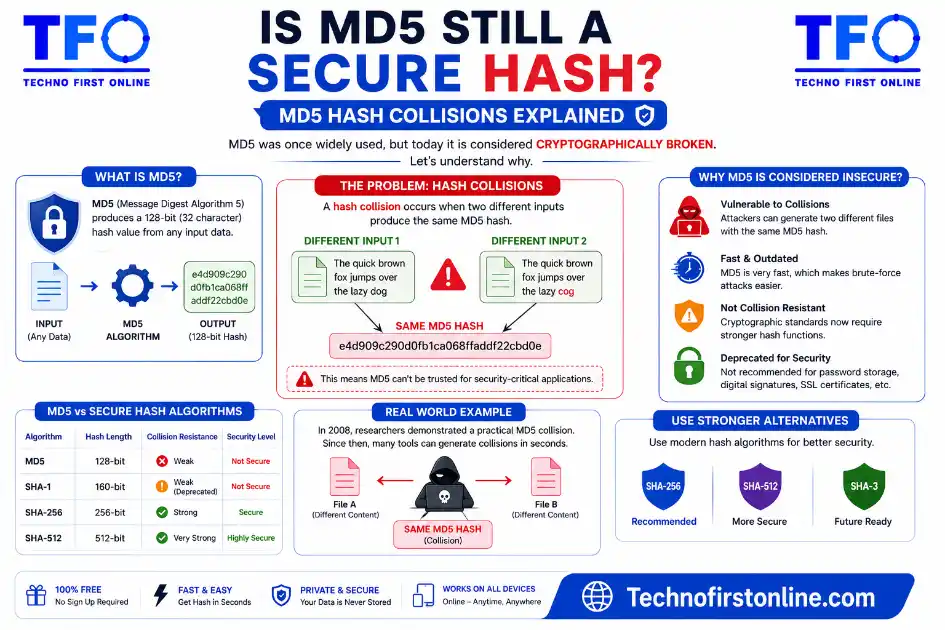
MD5 is no longer considered secure for cryptographic purposes because
researchers can deliberately create “collisions” — two different inputs
that produce the same hash. This makes MD5 unsafe for passwords, digital
signatures, and certificates. It’s still acceptable for non-security
tasks like file integrity checks, deduplication, and caching, where no
one is actively trying to forge a match.
Hash Collisions Explained
If you’ve spent any time reading about hashing, you’ve probably come across a warning that sounds something like “MD5 is broken” or “never use MD5 for passwords.” But what does that actually mean? MD5 still produces a valid-looking hash every single time you run it, so how can it be “broken”?
The answer comes down to one specific weakness called a collision — and once you understand what a collision actually is, the whole “is MD5 safe” debate suddenly makes a lot more sense. In our MD5 Hash Generator guide, we covered what MD5 is and how to generate one. This article goes one level deeper and explains exactly why security experts no longer trust it, where it’s still genuinely fine to use, and what to switch to if you’re building something new.
What Is a Hash Collision?
Every hash function, including MD5, takes an input of any length and squeezes it down into a fixed-size output — in MD5’s case, a 32-character string. Mathematically, this creates an interesting problem: there are infinitely many possible inputs, but only a finite number of possible 32-character outputs. That means, somewhere out there, two completely different inputs must eventually produce the exact same hash.
This is called a collision.
In theory, every hash function has collisions because of simple math (this is sometimes explained using the “pigeonhole principle” — if you have more pigeons than holes, at least one hole has to hold more than one pigeon). A good hash function makes finding those collisions so computationally expensive that it’s effectively impossible with current technology. A broken hash function, on the other hand, makes it realistically possible for someone to find a collision on purpose — and that’s exactly what happened to MD5.
Why MD5 Collisions Are a Big Deal
Finding a random, accidental collision isn’t usually the concern. What matters is whether someone can deliberately craft two different pieces of data that produce the same hash, on purpose, in a reasonable amount of time. If they can, that opens the door to some serious problems:
1. Forged digital signatures. Many systems use a hash to “fingerprint” a document before signing it digitally. If an attacker can create a malicious file that hashes to the same value as a legitimate, already-signed file, the malicious file would appear to carry a valid signature too — even though nobody actually approved it.
2. Fake security certificates. Some early certificate authorities used MD5 to sign SSL/TLS certificates. Researchers demonstrated that this weakness could be exploited to create a fraudulent intermediate certificate that browsers would have trusted as if it came from a legitimate authority.
3. Malware disguised as safe files. If checksums are used to confirm that a file hasn’t been tampered with, an attacker who can engineer a collision could swap a clean file for a malicious one without the checksum catching the difference.
4. Password authentication bypass. In systems that still rely on MD5 for storing or comparing credentials, a cleverly crafted collision could potentially let someone authenticate without knowing the real password.
None of this means your everyday MD5 checksum is suddenly dangerous — context matters a lot here, and we’ll get into that shortly.
How Were MD5 Collisions Actually Discovered?
MD5 wasn’t broken overnight. Cryptographers had quietly suspected weaknesses in MD5’s internal structure for years before anyone produced a working collision.
Timeline of MD5's Security Breakdown
-------------------------------------
1991   MD5 designed by Ronald Rivest, published as RFC 1321
1996   First theoretical weaknesses identified in MD5's compression function
2004   Researchers Wang & Yu publicly demonstrate a working MD5 collision
2005   Faster collision-finding techniques reduce attack time to minutes
2008   Forged SSL certificate created using an engineered MD5 collision
2012   The "Flame" malware exploits an MD5 collision to forge a digital signature
The turning point came in 2004, when cryptography researchers Xiaoyun Wang and Hongbo Yu published a method for generating MD5 collisions in a practical amount of time, rather than the astronomical timeframes that would have made the attack purely theoretical. Their technique was refined over the following years until collisions could be generated on an ordinary laptop in minutes.
A few years later, security researchers used this same weakness to forge a fraudulent SSL certificate, proving that the vulnerability wasn’t just an academic curiosity — it could be weaponized against real-world internet infrastructure. This issue became serious enough that it was formally tracked as a known vulnerability, documented in CERT/CC’s official vulnerability note on MD5 collision weaknesses, which describes how attackers can use the flaw to generate cryptographic tokens or certificates that falsely appear authentic.
Is MD5 “Broken” or Just “Weakened”?
This distinction matters more than people realize. There are actually a few different types of attacks a hash function needs to resist:
- Collision resistance — it should be hard to find any two inputs that produce the same hash. MD5 fails this completely.
- Pre-image resistance — given a hash, it should be hard to find any input that produces it. MD5 is weaker here than it used to be, but this is still far harder than finding a collision.
- Second pre-image resistance — given a specific input, it should be hard to find a different input with the same hash. This is also weakened in MD5, though less severely than full collision resistance.
So when people say “MD5 is broken,” they specifically mean its collision resistance has completely failed — not that anyone can instantly reverse a hash back into the original password or message. That distinction is important, because it explains why MD5 checksums are still fine for casual file verification but completely unsuitable for anything where an adversary might intentionally try to fool the system.
When MD5 Is Still Genuinely Fine to Use
It’s easy to read all of this and assume MD5 should never be touched again, but that’s an overcorrection. MD5 remains a reasonable choice in situations where nobody is actively trying to defeat it:
- Checking accidental file corruption after a download or transfer, where you’re comparing your own copy against a known-good checksum and there’s no adversary trying to forge a match.
- Detecting duplicate files in storage systems, backups, or deduplication pipelines, where speed matters more than cryptographic strength.
- Generating cache keys or short identifiers for internal application logic, where security isn’t the goal at all.
- Working with legacy systems that already depend on MD5 and aren’t handling anything security-critical.
If you want a refresher on these everyday use cases, we covered them in detail in our guide on how to generate and verify MD5 hashes online, including a step-by-step walkthrough using our free browser-based tool.
When You Should Never Use MD5
On the flip side, there are specific situations where MD5’s weaknesses genuinely matter, and you should avoid it entirely:
- Storing or verifying passwords — use bcrypt or Argon2 instead, which are specifically built to resist both collisions and brute-force attacks.
- Digital signatures — use SHA-256 or stronger algorithms from the SHA-2 family.
- SSL/TLS certificates — modern certificate authorities have moved entirely to SHA-256 for exactly this reason.
- Any system where an attacker could benefit from forging a match — file authentication for sensitive software updates, blockchain-style integrity checks, or anything tied to trust verification.
What Should You Use Instead of MD5?
If you’re designing something new, here’s a quick decision guide:
Use Case                          →  Recommended Algorithm
-----------------------------------------------------------
Password storage                  →  Argon2 or bcrypt
Digital signatures / certificates →  SHA-256 (or stronger)
General file integrity checks     →  SHA-256 (more future-proof) or MD5
File deduplication / caching      →  MD5 is still acceptable
Blockchain / cryptographic proofs →  SHA-256 or SHA-3
If you want a deeper side-by-side comparison of these algorithms, including speed, security level, and ideal use cases, check out our full breakdown of MD5 vs SHA-256 vs Bcrypt.
A Simple Way to Think About It
Here’s an analogy that makes this easier to remember: think of MD5 like an old lock that still closes and looks secure from the outside, but a skilled locksmith now knows exactly how to pick it in under a minute. For locking a garden shed where nobody’s seriously trying to break in, that old lock is still perfectly fine. But you wouldn’t use it to secure a bank vault. MD5 works the same way — it’s still functional for low-stakes, non-adversarial situations, but it has no place protecting anything genuinely valuable.
A Real-World Example of an MD5 Collision Attack
Theory is one thing, but seeing how this actually played out in the real world makes the risk much easier to grasp. One of the most well-documented cases involved a piece of malware that used a forged digital certificate to make itself look like it came from Microsoft. The attackers engineered a deliberate MD5 collision between their malicious code and a legitimate certificate, which allowed the malware to appear cryptographically signed and trustworthy — even though it absolutely wasn’t.
This wasn’t a small-scale lab experiment. It was a real attack that affected systems in production environments, and it’s frequently cited in security research as proof that MD5 collisions aren’t just an academic talking point — they’re a demonstrated, exploitable weakness with real consequences. Incidents like this are exactly why every major browser, certificate authority, and security framework has since moved away from MD5 for anything related to trust or verification.
It’s worth noting that none of this required breaking MD5’s “pre-image resistance” (reversing a hash back to its original input). The attackers didn’t need to know what input produced a given hash — they only needed to find two different inputs that produced the same hash, which is a fundamentally easier (and now well-documented) problem.

TechnoFirstOnline provides powerful free online tools, expert tutorials, and smart digital resources to simplify everyday tasks. Explore SEO, image, AI, PDF, and productivity tools designed for everyone.
Other Useful Tools











Password Generator
Open
People Also Read


NTLM Hsah vs MD5 vs SHA

decrypt md5 hash

password salting explained

php password hash guide

What Is a Password Hash Generator

SHA-1 vs SHA-256 vs SHA-512 comparison

what is bcrypt beginners guide

md5 vs sha256 vs bcrypt

How Generate Hash Online

MD5 Hash Generator Online guide

WiFi QR Code Generator

LastPass vs Norton vs Bitwarden

Password Manager Pros & Cons

16 Character Password Generator

What Makes a Password Strong

Different Password for Every Website
Common Password Mistakes

Random Password Generator vs Manual Passwords

Strong Password Examples

How to Create a Strong Password
Need to generate an MD5 checksum or compare file hashes? Try our Hash Generator Online Free to create secure hashes directly in your browser.
MD5 is no longer considered secure for cryptographic applications because attackers can deliberately create collisions, meaning two different inputs produce the same hash value. While MD5 can still be used for non-security purposes like file checksums and duplicate detection, it should not be used for passwords, digital signatures, or SSL certificates.
Frequently Asked Questions
Yes, but only for non-security purposes like checking file integrity, detecting duplicate files, or generating cache keys. It should never be used for passwords, digital signatures, or certificates.
An MD5 collision happens when two different inputs produce the exact same MD5 hash. Since this can be deliberately engineered, it makes MD5 untrustworthy for any task where someone might benefit from forging a match.
Researchers Wang and Yu published a practical method for generating MD5 collisions, which was later refined to the point where collisions could be created on an ordinary computer in minutes.
Yes. SHA-256 produces a longer hash, has no known practical collision attacks, and is the current standard for security-sensitive applications like digital signatures and certificates.
Many systems use MD5 purely for convenience, like detecting file corruption or duplicate content, where collision resistance doesn’t actually matter. Replacing it in non-critical legacy systems is often not worth the engineering effort.
Not directly. A collision means two different inputs share the same hash, but exploiting that in a real password system usually requires very specific conditions. Still, MD5 should never be relied on for password storage today.