Smart IT tools
SHA-1 vs SHA-256 vs SHA-512: - comparison
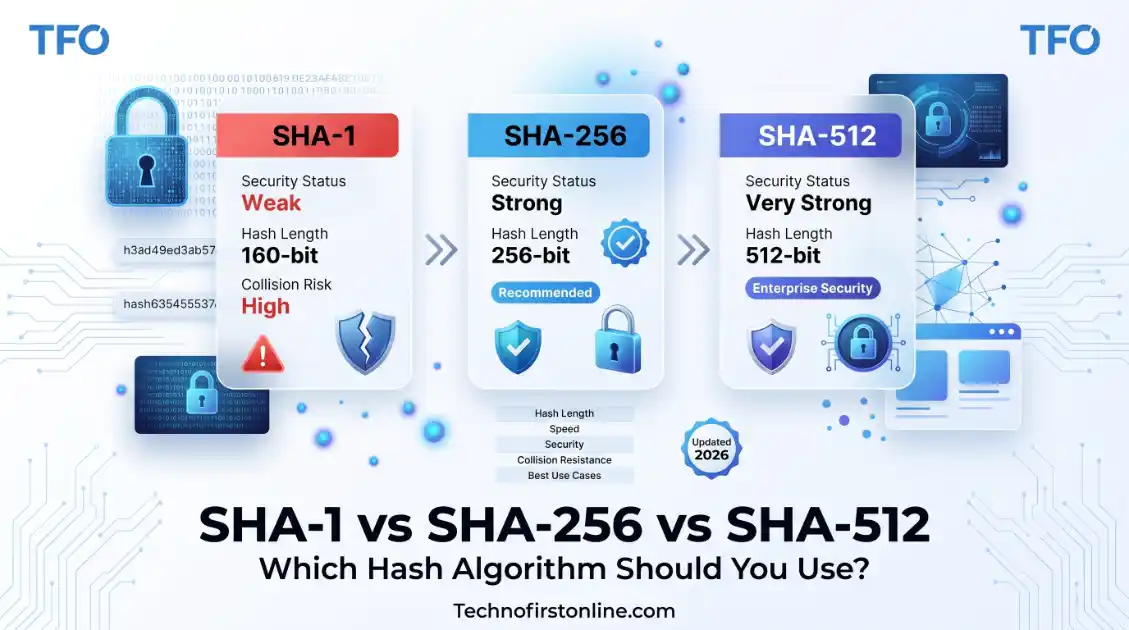
SHA-1 → 160-bit hash. Deprecated. No longer safe for
digital signatures or certificates. Still found
in legacy systems, but should be replaced.SHA-256 → 256-bit hash. Current standard. Secure, widely
supported, and the right choice for most tasks.SHA-512 → 512-bit hash. Maximum strength. Marginally
slower on 32-bit systems. Preferred for high-
security environments or very long documents.Rule: SHA-1 → avoid for new systems.
SHA-256 → default choice.
SHA-512 → when you need maximum security margin.
Which SHA Algorithm Should You Use?
The SHA family of hash functions has been the backbone of internet security for decades. But not all SHA algorithms are created equal — SHA-1, SHA-256, and SHA-512 have very different security profiles, output lengths, and ideal use cases. Choosing the wrong one can leave your system either outdated and vulnerable, or unnecessarily slow for something that didn’t need that level of strength.
If you’ve been trying to figure out the difference between SHA-1 vs SHA-256, or you’re weighing SHA-256 vs SHA-512 for a new project, this guide breaks it all down clearly. We’ll cover what each algorithm is, how they compare technically, and exactly which one you should be using for what purpose.
We’ve covered what MD5 is and how to generate hashes online, why MD5’s collision vulnerability broke its security, and done a full comparison of MD5 vs SHA-256 vs Bcrypt. This guide focuses specifically on the SHA family and picks up where those left off.
What Is the SHA Family?
SHA stands for Secure Hash Algorithm. It’s not a single algorithm — it’s a family of standards developed by the U.S. National Security Agency (NSA) and published by the National Institute of Standards and Technology (NIST) as official Federal Information Processing Standards (FIPS). The SHA family has gone through multiple generations:
- SHA-0 — the original, quietly retired due to a security flaw almost immediately after release.
- SHA-1 — the first widely adopted version, released in 1995 and used across internet infrastructure for years.
- SHA-2 — a family of stronger algorithms, including SHA-224, SHA-256, SHA-384, and SHA-512. This is the current generation.
- SHA-3 — a completely different design (not based on SHA-1 or SHA-2), standardized later as a backup in case SHA-2 was ever broken.
When people say “SHA-1 vs SHA-256 vs SHA-512,” they’re comparing one algorithm from the first generation (SHA-1) against two from the second (SHA-2). The comparison matters because they’re still found side by side in real-world systems, codebases, and configuration files.
SHA-1: The Retired Standard
SHA-1 was the dominant hashing algorithm for a long time. It powered SSL certificates, code signing, Git version control, and many other systems that form the foundation of the web as we know it. For years it was trusted — until the math started catching up with it.
Algorithm:        SHA-1
Designed by:      NSA
Published:        FIPS 180-1 (1995)
Output length:    160 bits → 40 hexadecimal characters
Block size:       512 bits
Rounds:           80
Collision status: Broken — practical collision demonstrated
NIST status:      Deprecated for digital signatures (SP 800-131A)
Current use:      Legacy only — not recommended for new systems
The critical moment came when researchers at Google and CWI Amsterdam published the SHAttered attack — a working, publicly demonstrated SHA-1 collision. They produced two different PDF files that had exactly the same SHA-1 hash, proving that SHA-1’s collision resistance had completely failed in practice, not just in theory. Google’s SHAttered project published both the collision files and the full technical methodology, making the vulnerability undeniable and public.
Before that, NIST had already been moving away from SHA-1. Under NIST Special Publication 800-131A, which provides official US government guidance on cryptographic transitions, SHA-1 was formally disallowed for generating digital signatures — meaning any system that still uses SHA-1 for signatures is out of compliance with federal security standards.
NIST SP 800-131A — SHA-1 Status:
──────────────────────────────────────────────────────
Use case                     SHA-1 Status
──────────────────────────────────────────────────────
Digital signature generation  Disallowed
Digital signature verification Legacy use only (limited)
Non-security checksums         Acceptable (with caution)
New system design              Not recommended
Source: csrc.nist.gov/pubs/sp/800/131/a/r2/final
SHA-256: The Current Standard
SHA-256 is where most serious security work happens today. It’s part of the SHA-2 family, uses a 256-bit output (displayed as a 64-character hexadecimal string), and has no known practical collision attacks. It’s the algorithm behind HTTPS certificates, Bitcoin, most software signing pipelines, and a huge range of application security infrastructure.
Algorithm:        SHA-256 (part of SHA-2 family)
Designed by:      NSA
Published:        FIPS 180-4 (2015, current version)
Output length:    256 bits → 64 hexadecimal characters
Block size:       512 bits
Rounds:           64
Collision status: No known practical attack
NIST status:      Approved — recommended for all new systems
Current use:      HTTPS, digital signatures, file integrity,
                  blockchain, code signing, API security
The reason SHA-256 hit the sweet spot is that it offers a massive improvement over SHA-1 in security while still being fast enough for real-world use. A server handling thousands of requests per second needs a hash function that won’t create a performance bottleneck, and SHA-256 delivers both speed and genuine cryptographic strength.
NIST specifies SHA-256 and the rest of the SHA-2 family in FIPS 180-4 — the Secure Hash Standard, which is the authoritative document that defines exactly how each algorithm processes data, what output lengths they produce, and which use cases each is approved for. SHA-256 is the go-to recommendation for most security contexts in that standard.
SHA-512: The High-Security Option
SHA-512 takes everything SHA-256 does and doubles the output length — producing a 512-bit hash displayed as a 128-character string. It’s also part of the SHA-2 family, standardized under the same FIPS 180-4 specification, and shares the same absence of known practical attacks.
Algorithm:        SHA-512 (part of SHA-2 family)
Designed by:      NSA
Published:        FIPS 180-4 (2015, current version)
Output length:    512 bits → 128 hexadecimal characters
Block size:       1024 bits
Rounds:           80
Collision status: No known practical attack
NIST status:      Approved — suitable for high-security applications
Current use:      High-value document signing, government systems,
                  financial infrastructure, long-term archive integrity
One interesting technical detail: SHA-512 actually uses 64-bit word operations internally, which means it can run faster than SHA-256 on 64-bit processors despite producing a longer output. On older 32-bit systems, it’s slower. For most modern servers and desktop systems, the performance difference between SHA-256 and SHA-512 is small enough that the choice comes down to security requirements rather than speed.
SHA-1 vs SHA-256 vs SHA-512: Side-by-Side Comparison
Now that each algorithm is clear, here’s the full picture in one place:
Feature              SHA-1          SHA-256        SHA-512
──────────────────────────────────────────────────────────────
Output bits          160            256            512
Output (hex chars)   40             64             128
Block size           512 bits       512 bits       1024 bits
Rounds               80             64             80
Collision safe       No             Yes            Yes
NIST approved        Partially*     Yes            Yes
Browser support      Being removed  Full           Full
Blockchain use       No             Yes (Bitcoin)  Limited
Performance (64-bit) Fast           Fast           Slightly slower
Performance (32-bit) Fast           Fast           Slower
Recommended for      Legacy only    Most use cases Max security
──────────────────────────────────────────────────────────────
* SHA-1 verification still allowed for legacy; generation disallowed
The SHA-1 vs SHA-256 decision is easy — if you’re building anything new, SHA-256 wins without discussion. The SHA-256 vs SHA-512 decision is more nuanced and usually comes down to whether the longer output and slightly higher computational cost is justified by your security requirements.
Which One Should You Actually Use?
Choose SHA-1 when: Honestly — almost never for new development. The only acceptable current use case is verifying old data or signatures that were already created with SHA-1 in legacy systems, where replacing it immediately isn’t practical. Even then, you should have a migration plan in place.
Choose SHA-256 when:
- Generating SSL/TLS certificates or working with certificate authorities.
- Signing code, software packages, or firmware updates.
- Verifying file integrity for downloads or backups.
- Working with APIs that require message authentication.
- Building anything blockchain-related.
- You want a modern, well-supported hash function with no known vulnerabilities.
SHA-256 covers the vast majority of everyday security use cases and is the safe default for developers who aren’t working in specialized high-security environments.
Choose SHA-512 when:
- You’re working in government, finance, or defense contexts where a larger security margin is standard or required.
- You’re hashing very large files where the additional output length provides meaningful extra assurance.
- Your system runs on 64-bit hardware and can take advantage of SHA-512’s native 64-bit operations without any performance penalty.
- Long-term archival integrity is important, and you want a hash that will hold up against future advances in computing.
For most developers and most projects, SHA-256 and SHA-512 are both fine choices — the security difference between them is currently theoretical rather than practical. The bigger gap is between SHA-1 and either of the SHA-2 options.
Generating SHA Hashes Online
If you need to generate a SHA-1, SHA-256, or SHA-512 hash right now — for testing, file verification, or development work — our free Hash Generator tool supports all three. Everything runs locally in your browser, so whatever you type or upload never leaves your device. No signup, no server upload, no waiting.
How Does SHA Compare to MD5 and Bcrypt?
A quick note for anyone coming from the broader hashing conversation: SHA-256 and SHA-512 are strong general-purpose hash functions, but they’re not suitable for password storage — just like MD5. For passwords, the right tool is bcrypt or Argon2, because both are intentionally slow and include automatic salting. We covered this in detail in our bcrypt beginner’s guide.
The short version: SHA functions are for data integrity, signatures, and certificates. Bcrypt is for passwords. These roles don’t overlap.

TechnoFirstOnline provides powerful free online tools, expert tutorials, and smart digital resources to simplify everyday tasks. Explore SEO, image, AI, PDF, and productivity tools designed for everyone.
Other Useful Tools










Password Generator
Open
People Also Read


NTLM Hsah vs MD5 vs SHA
decrypt md5 hash
password salting explained

php password hash guide
What Is a Password Hash Generator

what is bcrypt beginners guide
md5 vs sha256 vs bcrypt
Is MD5 Still Secure Hash Collisions Explained

How Generate Hash Online
MD5 Hash Generator Online guide

WiFi QR Code Generator

LastPass vs Norton vs Bitwarden

Password Manager Pros & Cons

16 Character Password Generator

What Makes a Password Strong

Different Password for Every Website
Common Password Mistakes
Random Password Generator vs Manual Passwords

Strong Password Examples
How to Create a Strong Password
Need to share software download links or security documentation? Create scannable codes using our Free QR Code Generator to instantly generate QR codes for URLs, text, email addresses, WiFi networks, SMS messages, and digital contact cards.
SHA-1, SHA-256, and SHA-512 are cryptographic hash algorithms used for data integrity and security. SHA-1 is deprecated due to collision attacks, SHA-256 is the recommended standard for most applications, and SHA-512 provides an even larger security margin for high-security environments.
Frequently Asked Questions
SHA-1 produces a 160-bit (40 character) hash and has a known, publicly demonstrated collision vulnerability, making it unsuitable for security-sensitive use. SHA-256 produces a 256-bit (64 character) hash, has no known practical attacks, and is the current recommended standard for digital signatures, certificates, and data verification.
Yes, significantly. SHA-256 produces a longer hash, uses a more complex internal structure, and has no known collision attacks. SHA-1 has been formally deprecated by NIST for digital signature generation, while SHA-256 is actively recommended for all new systems.
SHA-512 is used in high-security environments where a larger output length and security margin are required — such as government systems, financial infrastructure, and long-term archival integrity verification. It’s also faster than SHA-256 on 64-bit hardware because it’s internally optimized for 64-bit word operations.
Not necessarily — it depends on your use case. SHA-512 offers a larger output and a slightly higher theoretical security margin, but SHA-256 has no known vulnerabilities either. For most applications, SHA-256 is the better practical choice because it’s faster on 32-bit systems, more widely supported, and sufficient for current security requirements.
There are no known practical attacks against SHA-256’s collision resistance or pre-image resistance. While no algorithm can be guaranteed permanently safe, SHA-256 is considered secure by NIST and the global cryptography community for all current use cases.
SHA-256. SHA-1 is no longer considered safe for integrity verification in adversarial contexts. If you’re publishing checksums for software downloads or files, use SHA-256 or SHA-512 — most modern tools and package managers default to SHA-256 for this reason.
SHA-1 is deeply embedded in legacy infrastructure — older Git repositories, some certificate transparency logs, and certain older protocols still reference it. Replacing SHA-1 in large systems is a slow, complex process. The transition from SHA-1 to SHA-256 took years across the internet, and some older systems are still mid-migration.