Smart IT tools
Keyword Density Myths: Does It Still Affect Google Rankings?
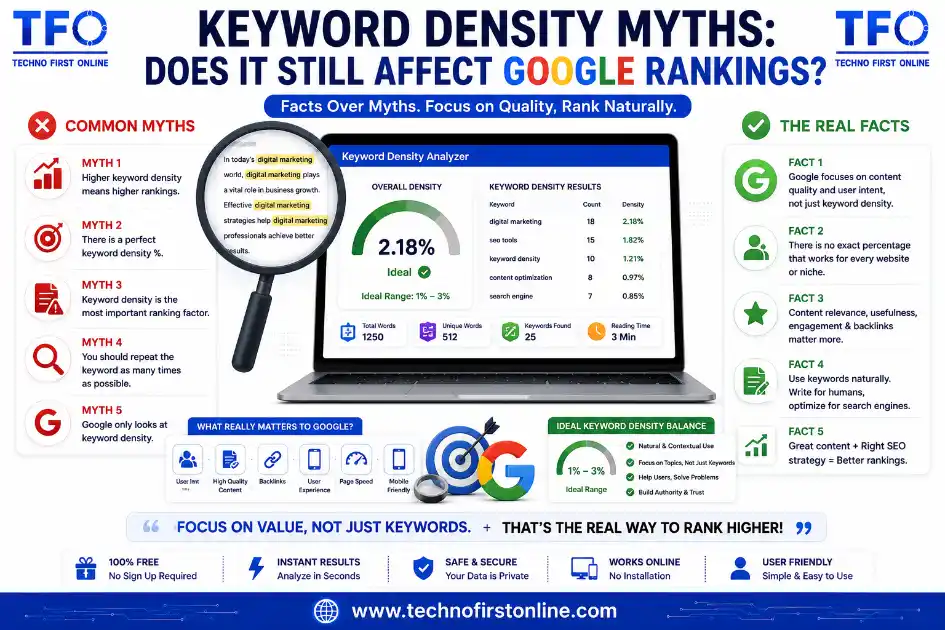
Keyword density myths persist largely from outdated SEO advice written when search algorithms genuinely relied on raw repetition counts to determine relevance. Modern Google rankings depend far more on relevance, user intent, and natural language understanding than any fixed percentage, meaning most of the specific “rules” still circulating today, like hitting an exact 2% target, don’t reflect how ranking systems actually evaluate content anymore.
Where These Myths Originally Came From
To understand why keyword density myths are so persistent, it helps to understand where they started. In the early 2000s, search algorithms were considerably simpler than today’s systems, relying heavily on matching exact keyword occurrences to determine what a page was about. Under those conditions, higher repetition genuinely did correlate with better rankings, at least until search engines caught on and started penalizing the obvious abuse that followed.
If you’re new to SEO and wondering what keyword density actually measures, it’s worth understanding the concept before evaluating common myths. Our detailed guide on “What Is Keyword Density” explains how keyword density is calculated, why writers still use it as a content review metric, and how it fits into modern on-page SEO.
That era produced a wave of SEO advice built around specific density targets, articles confidently stating a page needed exactly 2% or 3% keyword density to rank well. Those numbers weren’t entirely arbitrary at the time, they reflected genuine patterns in how early algorithms worked. The problem is that search technology moved on dramatically over the following two decades, while a surprising amount of that outdated advice kept circulating, copied and recycled across newer articles without anyone verifying whether it still applied.
How Google’s View of Keyword Density Has Evolved
The role of keyword density has changed significantly as search engines have become more advanced. In the early days of SEO, repeating an exact keyword frequently could have a noticeable impact on rankings because search algorithms relied heavily on keyword matching.
Over time, however, Google introduced more sophisticated ranking systems capable of understanding context, search intent, content quality, and natural language. Today, keyword density is best viewed as a simple content review metric rather than a ranking target. The timeline below highlights how the importance of keyword density has evolved over the years and why modern SEO focuses on creating helpful, relevant, and user-first content instead of chasing a specific percentage.
2006–2012
Search engines became better at detecting keyword stuffing and other manipulative SEO practices. Excessive repetition gradually became more of a risk than an advantage.
2013–2019
Google introduced smarter algorithms that focused more on search intent, semantic relationships, and overall content quality rather than exact keyword percentages.
2020–Today
Modern SEO prioritizes helpful, well-structured, and trustworthy content. Keyword density remains useful only as a diagnostic check to ensure natural keyword usage, not as a direct ranking factor.
Myth 1: There’s One Correct Density Percentage
This is probably the most persistent of all keyword density myths, the idea that some specific number, whether 1%, 2%, or 3%, represents the objectively correct target for every page. In reality, no such fixed number has ever been officially confirmed by Google, and the wide range genuinely useful content can occupy, from under 0.5% on long, thorough guides to slightly higher on short, focused pages, makes a single universal target impossible to justify.
The more accurate framing treats density as a loose sanity check within a broad range, not a precise target to hit exactly, adjusted based on content length and how naturally the term fits the writing.
One of the biggest misconceptions is that every page should reach the same keyword percentage. In reality, the ideal range depends on factors such as content length, topic depth, and search intent. If you’d like a more detailed explanation, our guide on Ideal Keyword Density explores practical recommendations and real-world examples for different types of content.
Myth 2: Higher Density Always Improves Rankings
This particular keyword density myth drives more bad SEO advice than almost any other misconception on the list. Repeating a keyword more often doesn’t push a page higher once density moves beyond a reasonable range, and past a certain point, it actively works against rankings by signaling manipulative intent rather than genuine topical coverage.
Modern algorithms weigh semantic relevance, meaning content that naturally discusses related concepts and synonyms tends to perform better than content obsessively repeating one exact phrase. A page about “email marketing” that also naturally covers open rates, segmentation, and automation demonstrates stronger topical authority than one that simply repeats “email marketing” as many times as possible while ignoring everything adjacent to the topic.
Myth 3: Keyword Density Is a Direct Ranking Factor
Many writers still treat density as though it functions like page speed or backlink count, a specific measurable input search engines directly score. This is one of the more technical keyword density myths, and it isn’t accurate. Density functions more as a diagnostic signal writers can use to catch over- or under-optimization before publishing, not as a metric Google’s algorithm directly rewards or penalizes at specific thresholds.
According to Google’s own documentation on how search ranking works, ranking systems evaluate hundreds of signals including relevance, content quality, usability, and context, none of which reduce to a single keyword frequency calculation. Treating density as one small self-check during editing, rather than a scoring input Google is directly measuring, reflects a far more accurate understanding of how modern search actually works.
Although keyword density isn’t a direct ranking factor, reviewing it can still help you identify content that’s unintentionally over-optimized or lacking topical focus. Our “Free Keyword Density Checker” provides a quick overview of keyword frequency, phrase distribution, and content balance, making it easier to spot potential issues before publishing without encouraging outdated SEO practices.
Myth 4: Every Page Needs the Exact Same Density Range
This one persists because it’s simpler to communicate than the more nuanced reality. A 300-word product page and a 3,000-word comprehensive guide behave completely differently when it comes to natural density. The guide has far more room to distribute related terms and subtopics, which naturally lowers its primary keyword’s percentage without indicating any problem, while the shorter page has less room to work with, so its primary term naturally makes up a larger share of the total content.
Applying one universal range to both formats produces misleading conclusions, flagging genuinely healthy long-form content as under-optimized, or flagging naturally higher short-form density as concerning when it’s actually appropriate for that format.
Myth 5: A Density Checker Tells You Everything You Need to Know
Even among writers who understand density is just one signal, there’s a common assumption that checking it covers the full picture of on-page optimization. It doesn’t. A keyword density calculator tells you nothing about title tag optimization, internal linking structure, page loading speed, mobile usability, or the dozens of other factors that meaningfully influence rankings alongside content quality.
Density checking remains a useful, quick habit, but treating it as a comprehensive SEO checklist on its own leads to over-focusing on one small piece while neglecting factors that likely matter considerably more in aggregate.
Myth 6: Keyword Stuffing Only Matters at Extremely High Percentages
Some writers assume stuffing only becomes a problem at obviously extreme levels, 10% or higher, and that anything below that threshold is automatically safe. In practice, unnatural repetition can read as forced well before hitting such extreme numbers, particularly when a phrase clusters heavily within a single paragraph even if the page-wide average looks reasonable. This is exactly the pattern covered in our guide on detecting and fixing keyword stuffing, where paragraph-level clustering often matters more than the overall page average.
Keyword stuffing isn’t always obvious. Sometimes repeated phrases within a single paragraph can create an unnatural reading experience even when the overall page density appears reasonable. Our Keyword Stuffing Guide explains how to recognize these patterns and improve content without sacrificing readability or search relevance.
Why These Myths Persist Despite Being Outdated
A few factors keep keyword density myths circulating long after they’ve stopped reflecting how search actually works. Older, highly-ranked articles from years past continue getting cited and copied by newer content, since search results themselves sometimes surface outdated advice prominently simply because it’s been around long enough to accumulate backlinks and authority. Additionally, density remains one of the easiest SEO concepts to measure and communicate, a specific percentage feels more actionable than vaguer, more accurate advice like “write naturally and cover the topic thoroughly,” even when the vaguer advice reflects modern best practice more accurately.
How to Spot Outdated Density Advice When Reading SEO Content
Given how many keyword density myths still circulate, it’s worth developing a quick filter for evaluating whether an article’s advice reflects current best practice or recycled outdated claims. A few warning signs are worth watching for:
Overly specific, unqualified percentages. Any article confidently stating “you need exactly 2.5% density to rank” without acknowledging that content length and format change what’s reasonable is likely repeating older advice rather than reflecting current understanding.
No mention of related terms or semantic coverage. Modern SEO advice generally discusses topical depth and related terminology alongside density. Articles that only ever mention one exact phrase, ignoring everything else a genuinely comprehensive piece would naturally include, tend to be working from an outdated framework.
Claims that density directly causes ranking changes. Genuinely current advice frames density as a diagnostic signal for writers, not a lever search engines directly score. Content that describes density as something you can “increase to boost rankings” is repeating one of the more persistent keyword density myths rather than reflecting how modern algorithms actually function.
No acknowledgment of keyword stuffing risk. Older advice sometimes encourages maximizing density without warning about the readability and trust costs of over-repetition, a gap that more current, balanced advice consistently addresses.
What Actually Matters More Than Density Today
Given how many keyword density myths circulate, it’s worth being explicit about what search engines genuinely weigh more heavily in current ranking systems: content depth and genuine expertise on the topic, natural language that reads well for actual humans, strong internal and external linking signals, page experience factors like loading speed and mobile usability, and overall site authority built through consistent, helpful publishing over time. Density checking remains useful as a small, quick sanity check within this broader picture, not as the primary lever driving rankings the way older advice suggested.
Reviewing keyword density becomes even more valuable when you look beyond a single page and evaluate your website as a whole. Our Website Keyword Density Audit Guide shows how to analyze multiple pages, identify keyword cannibalization, and prioritize content updates as part of a broader SEO strategy.
Some writers prefer checking keyword density directly from their browser using extensions, while others choose standalone web-based tools. If you’re unsure which approach fits your workflow better, our comparison of Keyword Density Checker Chrome Extensions explains the advantages, limitations, and privacy considerations of both options.
Why Choose TechnoFirstOnline Keyword Density Checker
Understanding the truth behind keyword density myths is only the first step—the next step is reviewing your own content with the right perspective. Our “Free Keyword Density Checker” is designed to help you evaluate keyword usage without encouraging outdated SEO practices or unrealistic percentage targets.
Instead of focusing on a single number, the tool provides keyword density analysis, keyword frequency reports, one-word to four-word phrase detection, word count, and content statistics to help you identify potential overuse or underuse naturally. Because everything runs directly inside your browser, your content remains on your device, making it a practical and privacy-friendly solution for bloggers, SEO professionals, content writers, and website owners who want to improve content quality while following modern SEO best practices.

TechnoFirstOnline provides powerful free online tools, expert tutorials, and smart digital resources to simplify everyday tasks. Explore SEO, image, AI, PDF, and productivity tools designed for everyone.
Other Useful Tools

















Password Generator
Open
People Also Read


website keyword density

Best free keyword density checker tools

Ideal Keyword Density
keyword density analyzer

Keyword Stuffing Checker

Keyword Density Calculator

How to Check Keyword Density
Word Density Checker vs Keyword Density Checker

What Is a Password Hash Generator

SHA-1 vs SHA-256 vs SHA-512 comparison

what is bcrypt beginners guide

md5 vs sha256 vs bcrypt

Is MD5 Still Secure Hash Collisions Explained

How Generate Hash Online

MD5 Hash Generator Online guide

How to Create a Custom QR Code for Free




stylish text generator

How to change to sentence case online
How to Automatically Change Capital Letters to Lowercase
Grammarly Word Count vs Free Word Counter

word counter google docs — How to Check Word Count

Word Count Checker — Check Word Count in PDFs & Documents
Free Character Counter Online — Count Letters & Spaces

How to Word Counter Online Free



While you're optimizing content across different browsers and devices, don't overlook your page URL. A clean and descriptive URL improves usability and helps search engines understand your content. Our Slug Generator makes it easy to create short, readable, and SEO-friendly slugs for every new page or article.
If you prefer avoiding browser extensions altogether, our Keyword Density Checker provides a simple browser-based alternative. It analyzes keyword density, keyword frequency, repeated phrases, and overall content statistics directly within your browser, so you can review your content without installing additional software or granting ongoing browser permissions.
Frequently Asked Questions
Not directly in the way older SEO advice suggested. Modern algorithms weigh relevance, content quality, and user intent far more heavily, though extreme over-repetition can still be flagged as a spam signal in some cases.
No. Google has never published a specific target percentage. The commonly cited 0.5% to 2.5% range comes from industry practice and observation, not official confirmation, and functions best as a loose guideline rather than a strict rule.
Much of this advice originated when early search algorithms genuinely relied more heavily on repetition, and it has continued circulating through copied and recycled content long after search technology moved past those methods.
Yes, particularly for long-form, comprehensive content that naturally covers many related subtopics, which dilutes any single term’s percentage without indicating a genuine relevance problem.
Yes, though the threshold for what reads as unnatural is often lower than many writers assume, especially when repetition clusters within a single paragraph rather than being evenly distributed across the full page.
Content depth, natural readability, strong internal and external linking, page experience factors like speed and mobile usability, and overall site authority all generally matter considerably more than any specific keyword percentage.