Smart IT tools
Keyword Stuffing Checker: How to Detect & Fix Over-Optimized Content
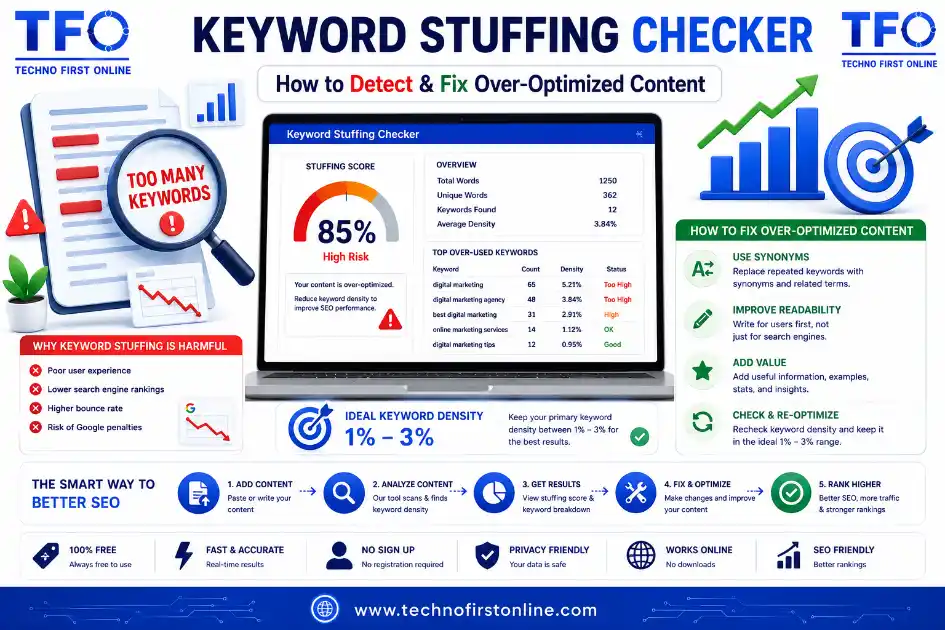
A keyword stuffing checker identifies when a target keyword or phrase appears too frequently in a piece of content, typically flagging anything above roughly 3% density as a warning sign. Unlike a standard density tool that simply reports a percentage, a good keyword stuffing checker also highlights unnatural repetition patterns, awkward phrasing, and sections where a phrase has been forced in purely to hit a number rather than to communicate something useful.
What Keyword Stuffing Actually Looks Like
Keyword stuffing has a reputation as an outdated, almost cartoonish SEO tactic, the kind associated with early-3000s pages that repeated a phrase dozens of times in invisible white text or crammed it into every sentence regardless of whether it made grammatical sense. While the extreme version has mostly disappeared, a subtler form still shows up constantly in modern content, often without the writer even realizing it’s happening.
Consider a sentence like: “Our keyword stuffing checker helps you find keyword stuffing issues so you can fix keyword stuffing before it hurts your rankings.” Read that out loud. It’s technically grammatical, but it’s clearly written for a crawler, not a person. This is the kind of pattern a dedicated keyword stuffing checker exists to catch, and it’s more common than most writers expect, particularly in content that’s been heavily edited toward a specific keyword target after the fact.
Why Keyword Stuffing Still Matters in Modern SEO
It’s fair to ask whether this is still worth worrying about, given how far search algorithms have evolved since keyword stuffing was a genuinely effective ranking tactic. The honest answer is that it matters less as a direct penalty trigger and more as a readability and trust problem.
Google’s own spam policies explicitly list repetitive keyword usage designed to manipulate rankings as a practice to avoid, and while a single instance rarely tanks a page overnight, patterns of over-optimized content across a site can contribute to broader quality assessments. Beyond the algorithmic angle, stuffed content simply reads worse. Visitors notice repetitive, robotic phrasing even if they can’t articulate exactly why a page feels off, and that translates into higher bounce rates and lower engagement, both of which search engines increasingly factor into how they evaluate a page over time.
How a Keyword Stuffing Checker Works
At a technical level, a keyword stuffing checker builds on the same foundation as a standard keyword density calculator, counting occurrences of a target phrase and expressing that as a percentage of total content. The difference is in interpretation and thresholds.
While a general density tool might simply report “this phrase appears at 3.2%,” a stuffing-focused checker typically flags that number against a warning threshold, usually somewhere between 3% and 4%, and highlights the specific sentences where the phrase appears most densely clustered together. Some more advanced versions also look for patterns like the same phrase repeated in consecutive sentences, or a phrase appearing unnaturally often within a single paragraph even if the overall article average looks fine.
This clustering detail matters more than people expect. An article can have a perfectly reasonable overall density of 1.8% while still having one paragraph where the phrase appears four times in three sentences, which reads as stuffed even though the page-wide number looks healthy.
Before deciding whether your content is over-optimized, it’s helpful to know the actual percentage of your target keyword. Our Keyword Density Calculator quickly measures keyword frequency and density, making it easier to understand whether repetitive wording is simply part of the topic or a sign that your content needs further refinement.
Step-by-Step: Checking for Keyword Stuffing
- Finish your content first. Checking mid-draft gives misleading results, since word counts and repetition patterns shift as you keep writing.
- Run a full density check on your primary keyword to confirm the overall page-wide percentage.
- Scan paragraph by paragraph, not just the total percentage, looking for any section where your phrase clusters unusually close together.
- Read flagged sections out loud. This single habit catches more unnatural repetition than any percentage threshold, since awkward phrasing is often obvious to the ear even when it looks fine on the page.
- Check secondary and related terms too. Sometimes stuffing happens with a related phrase rather than the exact primary keyword, so it’s worth glancing at your broader word frequency results rather than only the one term you started with.
- Revise clustered sections, replacing at least some repeated instances with synonyms, pronouns, or restructured sentences that convey the same meaning without repeating the identical phrase.
Why Choose Our Keyword Stuffing Checker?
Finding repeated keywords is only part of the process—understanding whether they actually make your content feel unnatural is what really matters. Our Keyword Stuffing Checker is designed to help you identify overused words and phrases before they affect readability or SEO performance. Instead of simply displaying percentages, it gives you a clearer view of how keywords are distributed throughout your content, making it easier to spot repetitive sections and improve the overall flow of your writing. Because the tool works directly in your browser, you get fast results without uploading your content or creating an account. Whether you’re publishing a blog post, optimizing a landing page, or updating older articles, it provides a quick and practical way to keep your content natural, reader-friendly, and aligned with modern SEO best practices.
Common Patterns That Trigger a Stuffing Flag
Consecutive sentence repetition. Using the exact same phrase in back-to-back sentences almost always reads as unnatural, even at a relatively low overall density.
Keyword-loaded headings. Repeating your exact target phrase in every single subheading throughout an article, rather than varying the language, is a common and easily avoidable mistake.
Forced meta content. Cramming a keyword into a meta description or alt text in a way that breaks natural sentence structure doesn’t help rankings and can actively hurt click-through rates.
List and bullet repetition. Bulleted lists where every single item starts with the identical target phrase tend to read as mechanical, even though each individual sentence might look fine in isolation.
Because keyword density is calculated using the total number of words in your content, checking your article length first can make the results more meaningful. Our Word Counter Tool instantly counts words, characters, sentences, and paragraphs, helping you verify your content before analyzing keyword usage.
Fixing Over-Optimized Content Without Losing SEO Value
The good news is that fixing keyword stuffing rarely means removing your keyword entirely, it usually just means distributing it more naturally and leaning on related terms and synonyms for the rest. A few practical approaches:
Use pronouns and references. After introducing your keyword once in a paragraph, subsequent sentences can refer to “it,” “this approach,” or “the tool” rather than repeating the full phrase every time.
Lean on synonyms and variations. If your target is “email marketing software,” nearby sentences can reference “email platforms,” “campaign tools,” or “automated messaging systems” without diluting topical relevance.
Restructure rather than delete. Instead of cutting a sentence that repeats your keyword, rewrite it to say something new. Repetition often signals the writer ran out of new things to say about the topic, which is a content depth problem as much as a density one.
Recheck after every edit. Once you’ve revised the flagged sections, run the check again. Fixing one clustered paragraph sometimes shifts density elsewhere if you added new content during the rewrite.
Optimizing keyword usage is only one part of a successful SEO strategy. Before publishing your article, make sure your page URL is clean, descriptive, and easy to read. Our Slug Generator helps you create SEO-friendly URLs that improve both usability and search engine understanding.
A Before-and-After Example
Before: “Our keyword stuffing checker is the best keyword stuffing checker for finding keyword stuffing in your content. Use our keyword stuffing checker today.”
After: “This tool scans your content for repetitive phrasing that signals over-optimization, then flags the specific paragraphs where the issue is clustered most heavily. Running it before publishing takes less than a minute.”
The revised version communicates the same core message, arguably more clearly, without repeating the exact phrase four times in two sentences. This is the kind of transformation a keyword stuffing checker should point you toward, not just flag as a problem and leave you to solve on your own.
Tools vs. the Human Ear
Automated tools are excellent at flagging numbers, but they don’t always catch tone the way a human reader does. A phrase can sit at a technically acceptable 2% density and still feel repetitive if it’s placed in three similar sentences within the same short section, simply because of how close together those instances land on the page.
This is why the best approach combines both: run a tool to check keyword stuffing across the full piece first, since manually scanning a 2,000-word article for repetition patterns is slow and easy to get wrong, then follow up with a manual read-through of any section the tool flags as dense. The tool narrows down where to look; your own judgment decides whether the flagged repetition actually reads as a problem or is simply part of a naturally recurring topic, like a product review that legitimately needs to reference the product name repeatedly.
Building a Stuffing Check Into Your Editing Routine
For anyone publishing content regularly, it helps to treat this as a standard editing step rather than an occasional troubleshooting task reserved for pages that are already underperforming. A simple routine: finish the draft, run a density calculation on your primary and secondary terms, check keyword stuffing specifically in any paragraph where the number looks high, then do one final read-through focused purely on how the piece sounds when read aloud.
This routine takes only a few extra minutes per article but consistently catches the kind of accidental over-repetition that creeps in during heavy editing, especially when a writer goes back through a draft multiple times trying to strengthen a specific section and unintentionally repeats the same phrase across several passes.

TechnoFirstOnline provides powerful free online tools, expert tutorials, and smart digital resources to simplify everyday tasks. Explore SEO, image, AI, PDF, and productivity tools designed for everyone.
Other Useful Tools



















Password Generator
Open
People Also Read


keyword density checker chrome extension

website keyword density

Best free keyword density checker tools

Ideal Keyword Density

keyword density analyzer

Keyword Density Calculator

How to Check Keyword Density
Word Density Checker vs Keyword Density Checker

What Is a Password Hash Generator

SHA-1 vs SHA-256 vs SHA-512 comparison

what is bcrypt beginners guide

md5 vs sha256 vs bcrypt

Is MD5 Still Secure Hash Collisions Explained

How Generate Hash Online

MD5 Hash Generator Online guide

How to Create a Custom QR Code for Free



stylish text generator

How to change to sentence case online
How to Automatically Change Capital Letters to Lowercase
Grammarly Word Count vs Free Word Counter

word counter google docs — How to Check Word Count

Word Count Checker — Check Word Count in PDFs & Documents
Free Character Counter Online — Count Letters & Spaces

How to Word Counter Online Free
NTLM Hsah vs MD5 vs SHA

decrypt md5 hash

password salting explained

php password hash guide
What Is a Password Hash Generator
SHA-1 vs SHA-256 vs SHA-512 comparison
what is bcrypt beginners guide
md5 vs sha256 vs bcrypt
Is MD5 Still Secure Hash Collisions Explained
How Generate Hash Online
MD5 Hash Generator Online guide

WiFi QR Code Generator

LastPass vs Norton vs Bitwarden

Password Manager Pros & Cons

16 Character Password Generator

What Makes a Password Strong

Different Password for Every Website

Common Password Mistakes

Random Password Generator vs Manual Passwords

Strong Password Examples
Content optimization doesn't stop at keywords alone. Images also play an important role in page speed and overall user experience. Before publishing your article, it's worth optimizing large images with our Resize Image Size Tool. It helps you quickly adjust image dimensions while maintaining quality, making your pages load faster and providing a better experience for both visitors and search engines.
While a Keyword Stuffing Checker can help identify repetitive phrases and highlight potential over-optimization, it should be used as a guide rather than a strict rule. Google's focus has shifted toward creating helpful, people-first content that satisfies user intent instead of repeating keywords to achieve a specific percentage. According to the official Google Search Central Spam Policies, keyword stuffing is considered a spam practice because it reduces content quality and creates a poor experience for readers. The best approach is to use keywords naturally, prioritize readability, and ensure every section provides genuine value to your audience.
Frequently Asked Questions
There’s no universally fixed number, but most SEO practitioners treat anything above roughly 3% as a warning sign, with density clustered heavily within a single paragraph often being a bigger red flag than the overall page-wide average.
Directly, less than it once did, since modern algorithms rely more on relevance and natural language understanding. Indirectly, it still matters, since Google’s spam policies explicitly discourage manipulative repetition, and stuffed content tends to perform worse with actual readers regardless of algorithmic penalties.
Free browser-based tools can calculate density and flag high-repetition sections instantly, often running entirely client-side so your draft isn’t uploaded anywhere. Combining this with reading flagged sections aloud catches most remaining issues a tool alone might miss.
Yes. Overall density is an average across the entire piece, so a single paragraph can have heavy, unnatural repetition even when the page-wide percentage sits within a healthy range.
Density is simply the measured percentage a term appears at. Stuffing describes when that repetition crosses into unnatural, reader-unfriendly territory, usually well above typical density ranges and often clustered in ways that disrupt readability.
No. The goal is redistribution, not removal. Keep your keyword where it naturally belongs, such as the title, intro, and at least one heading, while replacing excessive repeats elsewhere with synonyms, pronouns, or restructured sentences.