Smart IT tools
Word Density Checker vs Keyword Density Checker: Are They the Same Thing?
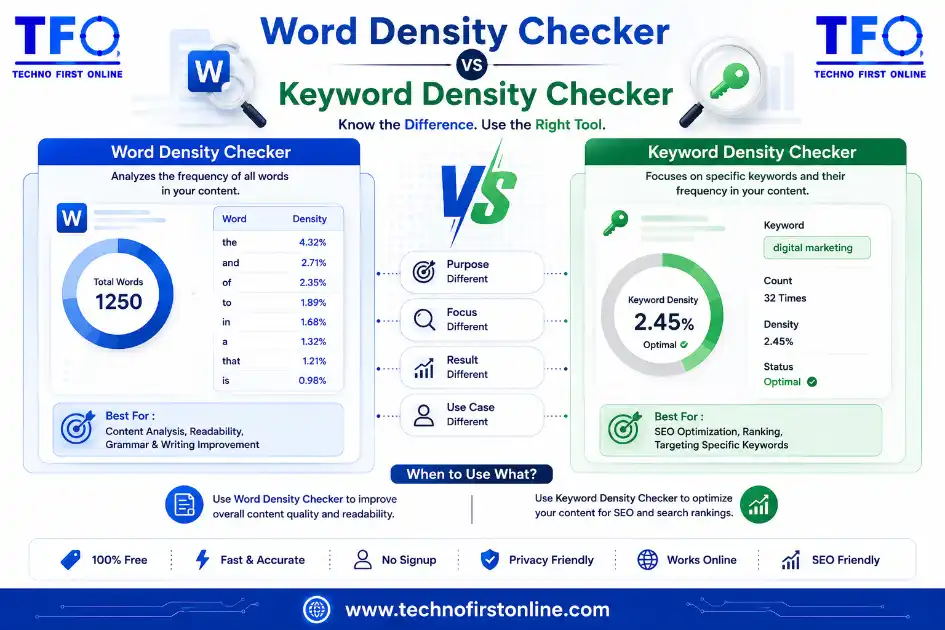
A word density checker and a keyword density checker rely on the same underlying calculation — counting how often a term appears relative to total word count — but they’re used differently. The former scans an entire text to surface whatever terms show up most, while the latter focuses on one target phrase you’ve already chosen. Most modern tools now combine both functions into a single interface.
Two Names, One Core Calculation
If you’ve spent any time researching on-page SEO, you’ve probably run into both phrases, sometimes used interchangeably, sometimes treated as if they measure entirely different things. That confusion is fair, since the two sit closer together than most articles admit.
At their core, both tools work off the same formula: take the number of times a term appears, divide it by the total word count, and multiply by 100. The output is a percentage. Where they diverge is intent. One approach is broad — it scans a full piece of content and ranks every repeated term by frequency, without you specifying anything in advance. The other is targeted — you tell it which word or phrase matters, and it reports back exactly how often that term shows up.
Think of it this way: a general frequency scan discovers patterns on its own, while a targeted check confirms a hypothesis you already had going in.
Before comparing word density and keyword density, it’s useful to understand the overall size of your content. Our Word Counter Tool instantly calculates total words, characters, sentences, paragraphs, and reading time, giving you the basic metrics needed before analyzing keyword frequency or density.
How the Broader Tool Works
When you paste an article into this kind of scanner, it typically breaks the text into individual tokens, strips out punctuation, and counts every unique term. Many versions also let you exclude common stop words like “the,” “and,” or “is,” since these would otherwise dominate the results without offering much SEO insight.
Once the counting is done, results get ranked by frequency, usually showing the top 20 to 50 terms along with their percentage. This gives you a bird’s-eye view of what your content is actually about, based purely on repetition — which is often revealing. Writers sometimes discover a secondary term appears more often than their intended focus phrase, or that a filler word crept in dozens of times without anyone noticing while drafting.
This wide-scan approach is especially useful during editing, before you’ve locked in an exact target, or when auditing older content to understand what it’s currently optimized around.
Once you’ve identified the most frequently used words in your content, the next step is optimizing your page for search engines. Our Meta Tag Generator helps you create SEO-friendly title tags, meta descriptions, and other important metadata that work together with proper keyword optimization.
How the Targeted Tool Works
The targeted version flips the workflow. Instead of surfacing whatever appears most often, you enter your chosen phrase first, and the results show exactly how many times it appears and what share of the total content it represents.
This is the more common use case once you already have a defined SEO goal. If you’re writing a page meant to rank for “affordable web hosting,” you don’t need a general frequency report — you need to know whether that exact phrase, and its close variations, show up often enough to signal relevance without tipping into stuffing.
Quality versions of this tool also support multi-word phrase analysis, since real targets are rarely single words. Measuring a three-word phrase requires scanning the text in sliding windows of three words at a time, rather than counting single tokens — a detail that separates a genuinely useful keyword density checker from a basic word counter.
Clean and descriptive URLs also play an important role in on-page SEO. Before publishing your optimized content, you can generate short, search-engine-friendly URLs using our Slug Generator making your pages easier for both users and search engines to understand.
Where the Two Overlap
In practice, the line has blurred significantly. Most modern SEO tools — including free browser-based ones — now combine both functions into one interface. You get a full frequency table of every repeated term, plus a dedicated search box where you can check the exact share held by your specific target.
This combined setup makes sense because SEO writing rarely happens in isolation. You typically want both views: the broad picture of what a piece naturally emphasizes, and the precise number for the phrase you’re actually trying to rank for. Relying on only one half leaves gaps. A pure frequency scan won’t tell you if your primary term is underused, since it only reports what’s already common. A pure targeted check won’t warn you if an unrelated word has quietly taken over the page’s focus.
Many content creators also review whether their articles sound natural after optimization. If you’re working with AI-assisted writing tools, our AI Content Detector can help identify AI-generated patterns, allowing you to improve readability before publishing.
Which One Should You Actually Use?
The honest answer is that you should use both functions, ideally within the same word density checker, at different stages of writing.
Early draft stage: Run a full frequency scan to see what your content naturally emphasizes. This confirms the piece is topically focused before you’ve even thought about exact percentages.
Pre-publish stage: Switch to targeted checking. Enter your primary phrase and confirm it falls within a healthy range — generally between 0.5% and 2.5% for most content types — without dominating the page unnaturally.
Audit stage: For existing published content, a broad scan is often more useful, since it reveals what a page is currently built around, which may have shifted after edits or additions over time.
If you’re optimizing for a single, clearly defined term, going straight to a keyword density checker gets the job done faster. If you’re doing a wider content audit or don’t yet have a fixed target, the broader scanning approach gives you a fuller picture.
If your goal is to optimize a specific keyword rather than simply reviewing overall word frequency, try our browser-based Keyword Density Checker. It analyzes keyword frequency, density percentage, and repeated phrases in real time without uploading your content to any server.
A Quick Comparison
| Aspect | Broad Frequency Scan | Targeted Keyword Check |
|---|---|---|
| Primary use | Discover frequent terms | Confirm density of a chosen phrase |
| Input required | None (scans everything) | A specific keyword or phrase |
| Best for | Content audits, early drafts | Pre-publish SEO optimization |
| Output | Ranked list of repeated terms | Exact percentage for one term |
| Multi-word phrase support | Sometimes | Usually essential |
Why This Distinction Matters for SEO
It might sound like a semantic argument, but understanding the difference actually changes how you approach content optimization. Writers who rely solely on a targeted check sometimes hit their percentage perfectly while missing the fact that a completely unrelated word dominates the rest of the page — something only a full scan would catch.
On the flip side, relying only on general frequency data without ever confirming your primary phrase’s exact share can leave you guessing whether content is genuinely optimized for the term you actually want to rank for.
According to Google Search Central’s spam policies, content created primarily to manipulate search rankings — including excessive or unnatural keyword repetition — falls under practices Google actively discourages. Checking density, in either form, exists to help you stay on the right side of that line, not by hitting a magic number, but by catching unnatural patterns before a page goes live.
Successful SEO depends on more than keyword optimization alone. Strong passwords help protect your website, CMS accounts, and SEO tools from unauthorized access. You can generate secure passwords instantly with our Password Generator.
Common Misconceptions
“Higher density always means better rankings.” This hasn’t been true for a long time. Search engines weigh relevance, user intent, and natural language far more heavily than raw repetition counts today.
“The two tools give different numbers for the same term.” They shouldn’t. Check the exact same phrase using a full scan versus a targeted search, and the percentage should match, since both use the identical formula underneath.
“You only need one or the other.” As covered above, each serves a different stage of the writing process. Treating them as interchangeable in every situation means missing insights one method surfaces that the other doesn’t.
While editing content, consistent text formatting also improves readability. Whether you’re fixing headings or preparing keyword lists, our Case Converter lets you quickly convert text into uppercase, lowercase, sentence case, or title case without manual editing.
A Real-World Example
Suppose you’ve written a 2,000-word guide about home coffee brewing, and your primary target phrase is “best coffee grinder.” Running a broad frequency scan first might reveal that “coffee” appears 40 times, “grinder” appears 22 times, and “burr” (a related term) shows up 15 times — useful context, but not yet the answer you actually need.
Switching to a targeted check for the exact phrase “best coffee grinder” might show it appears 9 times across the piece. That works out to roughly 1.35%, comfortably inside the healthy range most SEO writers aim for. Without running both checks, you’d only have half the picture: either a vague sense of what the article emphasizes, or a single number with no context for how it fits into the broader content.
This is also where multi-word phrase support earns its keep. A tool limited to single-word counts would only tell you “coffee” and “grinder” appear often, without ever confirming whether they appear together, in that order, often enough to matter for your actual target phrase.
Looking for an all-in-one SEO writing assistant? Our free Keyword Density Checker combines word frequency analysis, keyword density calculation, multi-word phrase detection, and keyword stuffing analysis in a single browser-based tool. No registration, no uploads, and no server processing required.
Why Choose Our Keyword Density Checker
Our Keyword Density Checker is designed to help bloggers, SEO professionals, content writers, and website owners optimize their content with confidence. In addition to calculating keyword density, it provides word count, character count, sentence and paragraph statistics, reading time estimates, keyword frequency analysis, and support for one-word to four-word phrase detection. The tool runs entirely in your browser, ensuring your content remains private while delivering fast, real-time results without relying on server-side processing. Whether you’re reviewing a blog post, landing page, or product description, it offers a simple and reliable way to improve on-page SEO before publishing.
Practical Tips for Better Results
A few habits make either type of check more useful in practice:
- Write first, measure second. Draft naturally around your topic before worrying about exact percentages. Retrofitting density into finished writing almost always produces awkward phrasing.
- Check variations, not just exact matches. Plurals, synonyms, and reordered phrases (“grinder for coffee” vs “coffee grinder”) all contribute to topical relevance even if a strict tool only counts exact matches.
- Re-run the check after every major edit. Adding or removing even a few paragraphs can shift percentages more than expected, especially in shorter content.
- Don’t chase a single “perfect” number. Treat the 0.5%–2.5% range as a sanity check, not a target to hit exactly. Content that reads naturally and covers its topic thoroughly will usually land somewhere sensible on its own.

TechnoFirstOnline provides powerful free online tools, expert tutorials, and smart digital resources to simplify everyday tasks. Explore SEO, image, AI, PDF, and productivity tools designed for everyone.
Other Useful Tools









Password Generator
Open
People Also Read



How to change to sentence case online
How to Automatically Change Capital Letters to Lowercase
Grammarly Word Count vs Free Word Counter
word counter google docs — How to Check Word Count
Word Count Checker — Check Word Count in PDFs & Documents
Free Character Counter Online — Count Letters & Spaces

How to Word Counter Online Free
NTLM Hsah vs MD5 vs SHA

decrypt md5 hash

password salting explained

php password hash guide

What Is a Password Hash Generator

SHA-1 vs SHA-256 vs SHA-512 comparison

what is bcrypt beginners guide

md5 vs sha256 vs bcrypt

Is MD5 Still Secure Hash Collisions Explained

How Generate Hash Online

MD5 Hash Generator Online guide

WiFi QR Code Generator

LastPass vs Norton vs Bitwarden

Password Manager Pros & Cons

16 Character Password Generator

What Makes a Password Strong

Different Password for Every Website

Common Password Mistakes

Random Password Generator vs Manual Passwords

Strong Password Examples
Everything runs locally inside your browser. Your content is never uploaded or stored on our servers, making it safe for confidential drafts and client content.
Our free Keyword Density Checker combines both word density analysis and targeted keyword density analysis in a single browser-based tool. You can instantly analyze one-word, two-word, three-word, and four-word phrases without uploading your content to any server.
Frequently Asked Questions
They rely on the same core formula but serve different purposes. One scans all text to surface the most frequent terms, while the other calculates the exact share held by a specific phrase you’ve chosen in advance.
Start with a broad frequency scan during your draft to confirm topical focus, then switch to targeted checking before publishing to verify your primary phrase sits within a healthy range.
Some can, though many basic versions only count single words. A combined tool that supports both single-word and phrase-level analysis gives the most complete picture.
No. These are diagnostic tools that help writers catch over-optimization or under-optimization before publishing, which indirectly supports better SEO outcomes rather than influencing rankings on their own.
Most SEO practitioners recommend keeping a primary term’s share between 0.5% and 2.5% of total word count, though this varies by content length and type.
Readability should always come first. If hitting a specific number requires awkward phrasing, it’s better to write naturally and let the percentage fall where it does.