Smart IT tools
How to Check Keyword Density
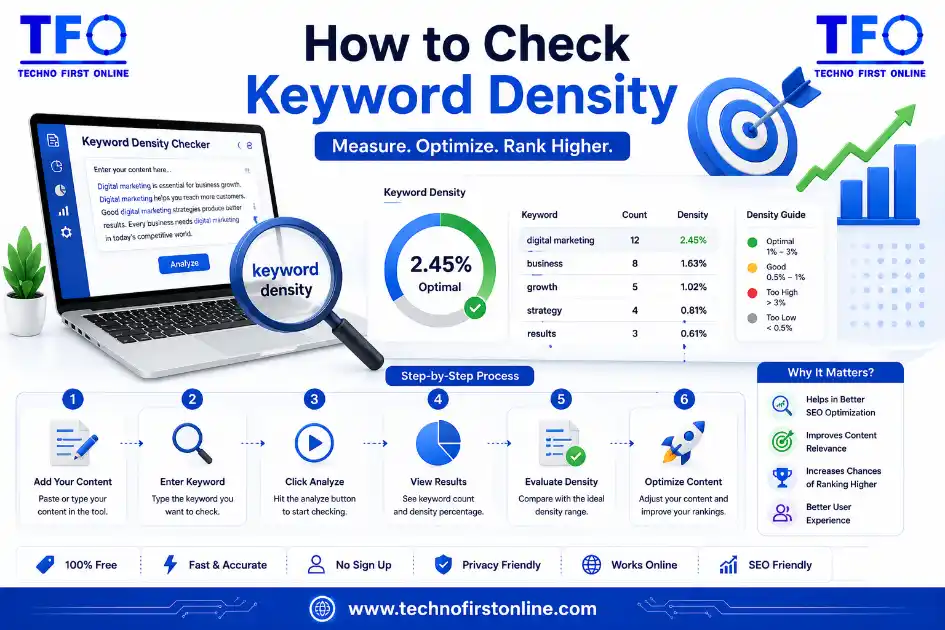
To check keyword density in an article, count how many times your target keyword or phrase appears, divide that number by the total word count, and multiply by 100. A free online tool automates this instantly, but understanding the manual process helps you interpret the results correctly and catch issues a tool alone might not flag, like awkward placement or missing variations.
Why we Check Keyword Density its Actually Matters
Every writer who’s optimized content for search engines has faced the same nagging question at some point: am I using my target keyword enough, or too much? Guessing rarely works well. Use it too rarely and your content might not signal enough topical relevance. Use it too often and you risk sounding repetitive, unnatural, or worse, triggering a keyword-stuffing red flag.
This is exactly why learning to check keyword density in an article is a core skill for bloggers, content marketers, and SEO specialists alike. It removes the guesswork and replaces it with an actual number you can act on.
The process itself isn’t complicated, and you don’t need advanced tools or technical knowledge to do it well. What matters more is understanding what the number means once you have it, and how to use that insight to improve your writing rather than distort it.
Step 1: Finalize Your Draft Before Checking
It’s tempting to check density mid-draft, but this often leads to premature optimization. Write your article naturally first, covering the topic thoroughly without obsessing over exact keyword counts. Content written with density as the priority from sentence one tends to read stiffly, and readers notice long before search engines do.
Once your draft feels complete and covers the subject with genuine depth, that’s the right moment to move to the next step.
Step 2: Identify Your Primary and Secondary Keywords
Before running any check, know exactly what you’re measuring. Your primary keyword is the main phrase you want the page to rank for. Secondary keywords are closely related terms or variations that support the same topic without being the exact focus.
For example, if your primary target is “healthy breakfast recipes,” secondary terms might include “quick breakfast ideas,” “morning meal prep,” or “protein breakfast.” Knowing these in advance means you can check density for each one, rather than fixating on a single phrase and ignoring how the rest of your content supports it.
Step 3: Paste Your Content Into a Density Checker
This is where a dedicated tool saves significant time. Manually counting keyword occurrences in a 2,000-word article by scrolling and tallying is slow and error-prone, especially for multi-word phrases where you also need to track exact ordering.
Paste your full article into a keyword density checker, and it will instantly return a breakdown of every repeated word and phrase, along with the total word count and percentage for each. Good tools also let you check a specific keyword directly, rather than scrolling through a full ranked list to find it.
Look for a tool that supports phrase-level analysis, not just single words, since most real target keywords are two or three words long. A checker limited to single-word counts will miss whether “morning meal prep” appears as an exact phrase, even if “morning,” “meal,” and “prep” individually show up often.
If you don’t want to calculate keyword density manually every time, using a dedicated Keyword Density Checker can save a significant amount of time. It instantly analyzes your content, shows keyword frequency, and breaks down single-word, two-word, and three-word phrases in one report. This makes it much easier to identify overused terms and optimize your content before publishing.
Step 4: Interpret the Percentage Correctly
Once you have your number, resist the urge to treat it as a strict pass-or-fail grade. A commonly cited healthy range for primary keywords is between 0.5% and 2.5%, though this varies based on content length and type. Shorter pieces can sit slightly higher without feeling forced, while longer, in-depth guides usually perform better with a lower, more evenly distributed density.
If your primary keyword falls well below 0.3%, it’s worth reviewing whether the content genuinely addresses the topic in enough depth, or whether the keyword simply needs to be worked in more naturally, particularly in the introduction, at least one subheading, and the conclusion.
If it’s sitting above 3%, read the flagged sentences aloud. Unnatural repetition is usually obvious once you hear it, even if it looked fine on the page.
Step 5: Check Placement, Not Just Percentage
Density alone doesn’t tell the full story. Where your keyword appears matters as much as how often. A phrase used only once, buried in the middle of a long paragraph, carries less SEO weight than the same phrase appearing in your title, opening paragraph, and at least one heading.
After checking overall density, scan your article structure specifically for these placement points:
- Title and H1 — your primary keyword should appear here naturally
- First 100 words — helps confirm topical relevance early
- At least one subheading — reinforces structure and scannability
- Meta description — supports click-through rate, even though it doesn’t directly affect density calculations
- Conclusion — reinforces the topic one final time
After optimizing your content, don’t overlook your metadata. An engaging SEO title and meta description can improve click-through rates from search results. You can generate optimized metadata quickly with a Free Meta Tag Generator, ensuring every page has search-friendly tags without spending extra time writing them manually.
Step 6: Cross-Check Related Terms
Modern SEO rewards more than a single repeated phrase. Search engines increasingly rely on semantic understanding, meaning content that naturally includes related terms and synonyms tends to perform better than content obsessively repeating one exact phrase.
After confirming your primary keyword’s density, run a broader scan of your entire article to see which other words and phrases appear frequently. This often reveals whether you’ve naturally covered supporting subtopics, or whether the article leans too heavily on one term while neglecting related concepts a reader would expect to see covered.
Step 7: Revise Without Sacrificing Readability
If your check reveals an issue, whether too high, too low, or oddly placed, revise with readability as the priority, not the percentage. Adding a keyword mechanically into an awkward spot to hit a number rarely helps rankings and often hurts user experience, which search engines increasingly factor into quality assessments.
Instead, look for natural opportunities: a heading you can rework, a sentence that already discusses the topic where the phrase fits organically, or a transition sentence in the conclusion that reinforces the article’s focus.
Choosing the Right Tool to Check Keyword Density
Not every density checker is built the same way, and the differences matter once you move past basic single-word counting. When picking a keyword density checker, look for a few specific capabilities:
Multi-word phrase support. As covered earlier, most real target keywords are phrases, not single words. A tool that only counts individual words will miss whether your exact phrase appears together, in order, the number of times you think it does.
A dedicated search function. Scrolling through a ranked list of every word in a 2,000-word article to find your one target phrase wastes time. A good keyword density checker lets you type in the exact phrase and get an instant, isolated answer.
Browser-based processing. Tools that run entirely client-side, without uploading your content to a server, are worth prioritizing, especially if you’re checking unpublished drafts or content under a client agreement. This also tends to make results appear instantly, since there’s no upload or server round-trip involved.
Stop-word filtering. Without this, common words like “the,” “and,” and “is” flood the top of your results and bury the terms actually worth analyzing.
Once you’ve settled on a reliable keyword density checker, make it a standard part of your pre-publish checklist, the same way you’d run a spell-check or a plagiarism scan before hitting publish.
Building Density Checking Into Your Workflow
The most consistent writers don’t treat this as a one-time task reserved for troubleshooting underperforming pages. They build it into a repeatable pre-publish routine: finish the draft, run a check, review placement, make small adjustments if needed, then publish. Over time, this becomes fast enough that it barely adds friction to the process, while still catching the occasional over-repeated phrase or thin section that would otherwise slip through unnoticed.
Imagine you’ve written an 1,800-word article targeting “beginner yoga poses.” After pasting it into a density checker, you find the exact phrase appears 14 times. Using the formula:
(14 ÷ 1,800) × 100 = 0.78%
That falls comfortably within the healthy range. Next, you check the broader frequency scan and notice “yoga” alone appears 45 times and “poses” appears 38 times, which confirms strong topical focus even beyond the exact target phrase. You also notice “stretching” appears only twice, despite being closely related, so you add a short section expanding on stretching benefits, which naturally improves topical coverage without inflating your primary keyword’s count.
Since keyword density is calculated based on your article’s total word count, it’s always a good idea to verify the number of words before analyzing keyword frequency. A reliable Word Counter Tool helps you quickly check your total words, characters, sentences, and paragraphs, ensuring your density calculations are as accurate as possible.
Common Mistakes When Checking Density
Checking too early. Running a check on an unfinished draft gives you a misleading number that will shift significantly once the piece is complete.
Ignoring word count changes. If you add or cut a large section after your initial check, density shifts even if you didn’t touch the keyword itself. Always re-check after major edits.
Focusing only on the exact match. Ignoring plural forms, synonyms, and reordered variations gives an incomplete picture of your actual topical coverage.
Treating the percentage as a ranking guarantee. Hitting a “perfect” density doesn’t guarantee rankings. It simply confirms your content isn’t obviously under- or over-optimized, which is one small piece of a much larger SEO picture.
Optimizing keyword density is only one part of on-page SEO. Before publishing your article, make sure your page URL is clean and descriptive. A well-structured URL created with a Slug Generator improves readability for users and helps search engines better understand your page’s topic.

TechnoFirstOnline provides powerful free online tools, expert tutorials, and smart digital resources to simplify everyday tasks. Explore SEO, image, AI, PDF, and productivity tools designed for everyone.
Other Useful Tools












Password Generator
Open
People Also Read





How to change to sentence case online
How to Automatically Change Capital Letters to Lowercase
Grammarly Word Count vs Free Word Counter

word counter google docs — How to Check Word Count

Word Count Checker — Check Word Count in PDFs & Documents
Free Character Counter Online — Count Letters & Spaces

How to Word Counter Online Free
NTLM Hsah vs MD5 vs SHA

decrypt md5 hash

password salting explained

php password hash guide

What Is a Password Hash Generator

SHA-1 vs SHA-256 vs SHA-512 comparison

what is bcrypt beginners guide

md5 vs sha256 vs bcrypt

Is MD5 Still Secure Hash Collisions Explained

How Generate Hash Online

MD5 Hash Generator Online guide

WiFi QR Code Generator

LastPass vs Norton vs Bitwarden

Password Manager Pros & Cons

16 Character Password Generator

What Makes a Password Strong

Different Password for Every Website

Common Password Mistakes

Random Password Generator vs Manual Passwords

Strong Password Examples
While keyword density can help you evaluate how naturally your target terms appear throughout an article, it should never become the primary focus of your content. Google recommends creating helpful, people-first content that satisfies user intent rather than aiming for a specific keyword percentage. As explained in the Google Search Central documentation on creating helpful, reliable, people-first content, writing for your audience and providing genuine value is far more important than repeating keywords to reach an arbitrary density. Use keyword density as a guide for optimization—not as a ranking formula.
Keyword density is just one of many on-page SEO signals. Modern search engines also evaluate content quality, topical relevance, and user experience. Industry resources like Moz's Beginner's Guide to SEO emphasize creating comprehensive, well-structured content that answers users' questions naturally instead of relying on excessive keyword repetition.
Frequently Asked Questions
Count how many times your target keyword appears, divide that number by the article’s total word count, then multiply by 100 to get a percentage. This works for both single words and multi-word phrases, as long as you count exact-phrase occurrences consistently.
Most SEO practitioners recommend keeping a primary keyword’s density between 0.5% and 2.5%, adjusting slightly based on the article’s length and how competitive the target keyword is.
Yes. Free browser-based tools exist that calculate density instantly without requiring sign-up, and many run entirely client-side, meaning your content isn’t uploaded anywhere.
Always check after your final edit. Checking mid-draft, before content is finished, gives you numbers that will shift once you add or remove sections.
Not directly in the way it did years ago. Modern algorithms weigh relevance, user intent, and natural language far more heavily, but extreme over-repetition can still be flagged as a spam signal.
A very low density, especially under 0.3%, may indicate your content doesn’t sufficiently address the topic, or that the keyword needs to be worked into key positions like the title, intro, and at least one heading.