Smart IT tools
Keyword Density Analyzer vs Keyword Density Checker: What's the Real Difference?
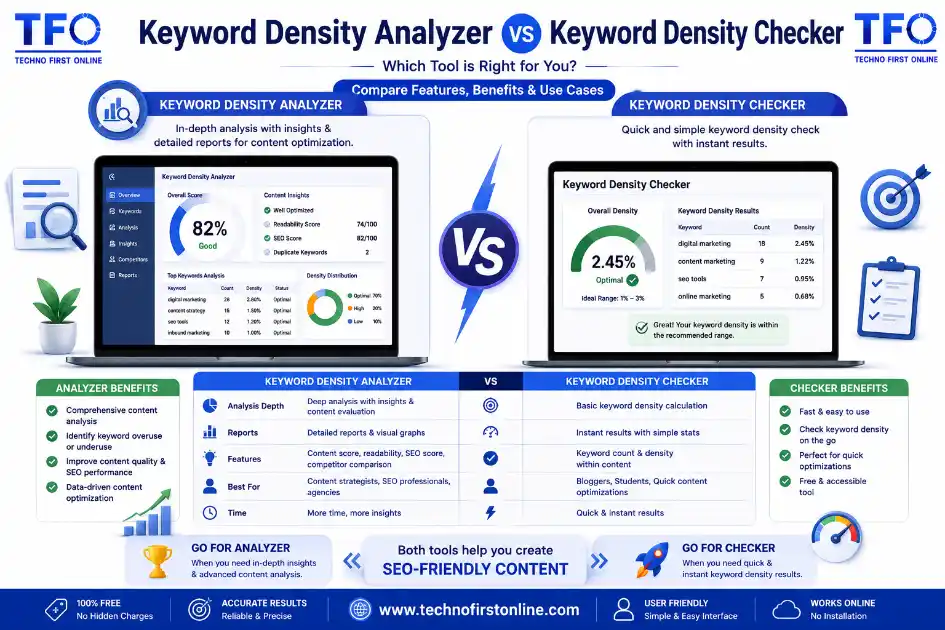
A keyword density analyzer and a keyword density checker are often used as interchangeable terms, and in most modern tools, they genuinely are the same thing. Where a distinction sometimes exists, “analyzer” tends to imply a deeper breakdown, covering related phrases, readability signals, and content structure, while “checker” often points to a simpler, single-purpose percentage lookup for one target keyword.
Why Two Names Exist for Similar Tools
SEO tooling has grown organically over the past two decades, with different developers naming similar features based on whatever made sense to them at the time. This is exactly why you’ll find “keyword density analyzer,” “keyword density checker,” “word density tool,” and half a dozen other near-identical labels all describing tools that, functionally, calculate the same core percentage.
That said, the word “analyzer” does carry a slightly different implication in software naming conventions generally. An analyzer suggests examining something from multiple angles, not just returning one isolated number. A checker, by contrast, implies verification against a known standard, closer to a spell-checker confirming whether something is correct or not. Whether a specific tool lives up to either implication depends entirely on what it actually does under the hood, not just what it’s called on the landing page.
What a Keyword Density Analyzer Typically Includes
When a tool markets itself specifically as a keyword density analyzer rather than a basic checker, it usually offers a few additional layers beyond the core percentage calculation:
Full content breakdown. Rather than reporting on a single target phrase, an analyzer typically scans the entire piece and ranks every repeated word and phrase by frequency, giving you a complete picture of what the content emphasizes, intentionally or not.
Multi-length phrase support. Good analyzers check single words, two-word phrases, and three-word phrases simultaneously, since real keyword targets vary in length and a tool limited to one format misses relevant patterns.
Stop-word filtering with customization. Beyond simply excluding common words like “the” and “and,” a more thorough analyzer often lets you adjust which words get filtered, useful when your niche has its own common filler terms worth excluding.
Contextual flagging. Some more advanced tools highlight not just density percentage but where in the content a phrase clusters, flagging paragraphs where repetition concentrates even if the page-wide average looks reasonable.
A more basic keyword density checker, by comparison, often just takes your input keyword and returns a single percentage, without the surrounding context that helps you actually act on the number.
If you’re mainly interested in checking how often a specific keyword appears in your content, a dedicated Keyword Density Checker is often the quickest solution. It provides an instant overview of keyword usage and helps you verify whether your primary phrase is distributed naturally before you publish your page.
Why Choose Our Keyword Density Analyzer?
A simple percentage can tell you how often a keyword appears, but it doesn’t always explain how your content is actually optimized. A Keyword Density Analyzer goes a step further by examining the overall distribution of words and phrases across your content, making it easier to identify repeated terms, keyword patterns, and sections that may need improvement. Instead of focusing on a single number, it provides a broader view of your writing so you can balance optimization with readability. Because the tool runs directly in your browser, your content stays private while the analysis is completed in seconds.
Whether you’re reviewing a new article or updating an older page, it offers a practical way to create content that feels natural for readers while supporting modern SEO best practices.
Where Google’s Own Guidance Fits Into This Discussion
It’s worth pausing here to note that neither a density analyzer nor a density checker exists in a vacuum separate from what search engines actually reward. According to Google’s own documentation on creating helpful, reliable content, pages should be written primarily for people, with search engine visibility as a secondary outcome of genuinely useful writing rather than the main goal driving every sentence. This context matters because it reframes what either type of tool should actually be used for: not chasing a specific number, but confirming that naturally written content hasn’t accidentally drifted into repetitive or thin territory.
This is also why the deeper features found in a proper keyword density analyzer tend to be more useful long-term than a bare-bones checker. Seeing the full picture, related terms, clustering, distribution, gives you actionable insight into whether your content genuinely serves the topic, rather than just confirming a single percentage sits in an acceptable range.
Single-Purpose Checker vs. Full Analyzer: A Practical Comparison
| Feature | Basic Checker | Full Analyzer |
|---|---|---|
| Single keyword lookup | Yes | Yes |
| Full frequency breakdown | Rarely | Yes |
| Multi-word phrase support | Sometimes | Usually |
| Related term suggestions | No | Sometimes |
| Paragraph-level clustering flags | No | Sometimes |
| Speed for a quick single check | Faster | Slightly slower due to extra processing |
Neither option is objectively better in every situation. If you already know your exact target keyword and just need to confirm one number quickly, a straightforward checker gets you there faster. If you’re doing a full content audit, especially on older published pages where you’re not entirely sure what the content currently emphasizes, a proper analyzer gives you the fuller diagnostic picture worth the extra few seconds of processing.
When “Word Density Analyzer” Enters the Picture
A closely related term, “word density analyzer,” adds one more layer of confusion worth addressing directly. This phrasing typically emphasizes the broad-scan function specifically, examining all words in a piece rather than one chosen target. Functionally, it overlaps heavily with the full-analyzer approach described above, and the distinction from “keyword density analyzer” is often more about marketing language than genuinely different functionality.
If you’ve read our breakdown comparing word density checkers and keyword density checkers, the same logic applies here: broad scanning tools and targeted lookup tools serve complementary purposes, and the best workflow uses both rather than picking one label and sticking to it exclusively.
How to Choose Between Tools in Practice
Rather than getting caught up in naming conventions, focus on what you actually need for a given piece of content:
- Doing a quick pre-publish check on one known keyword? A basic checker is faster and sufficient.
- Auditing an older page where you’re unsure what it currently emphasizes? A full analyzer’s broader breakdown reveals patterns a single-keyword lookup would miss entirely.
- Writing new long-form content? Use the broad analyzer view during drafting to confirm topical focus, then switch to a targeted check before publishing, similar to the workflow covered in our step-by-step guide to checking keyword density in an article.
- Concerned about over-optimization? Look for a tool with clustering detection, closer to what’s discussed in our guide on detecting and fixing keyword stuffing, since paragraph-level repetition often matters more than the page-wide average.
Since keyword density depends on the total number of words in your article, checking the word count first can make your analysis more accurate. Our Word Counter Tool instantly calculates words, characters, sentences, and paragraphs, making it a useful companion before running any density analysis.
A Worked Example Using Both Approaches
Imagine auditing a 1,600-word article you published a year ago, uncertain what it’s currently optimized around after several rounds of edits. Running a full analyzer scan first reveals that “budget travel tips” appears 6 times (0.75% density), while an unrelated phrase, “packing essentials,” unexpectedly appears 22 times (2.75%) because a section was heavily expanded during a later update.
Without the broad scan, you might have only checked your original target keyword, confirmed it looked fine at 0.75%, and published an update without ever realizing the piece had quietly shifted toward emphasizing packing content more than the travel-tips angle the title still promises. This is exactly the kind of insight a single-purpose checker would miss, while a fuller analyzer catches it immediately.
A Note on Terminology Drift Over Time
Tool naming in SEO software tends to drift as vendors compete for slightly different search terms rather than genuinely different functionality. This is worth keeping in mind whenever you’re comparing options: read the feature list, not just the product name, before assuming one tool offers meaningfully more than another. Two products called entirely different things might process your content identically under the hood, while two products with nearly identical names might differ significantly in what they actually report back.

TechnoFirstOnline provides powerful free online tools, expert tutorials, and smart digital resources to simplify everyday tasks. Explore SEO, image, AI, PDF, and productivity tools designed for everyone.
Other Useful Tools











Password Generator
Open
People Also Read
keyword density checker chrome extension

website keyword density

Best free keyword density checker tools
Ideal Keyword Density
Keyword Stuffing Checker
Keyword Density Calculator
How to Check Keyword Density
Word Density Checker vs Keyword Density Checker

What Is a Password Hash Generator

SHA-1 vs SHA-256 vs SHA-512 comparison

what is bcrypt beginners guide

md5 vs sha256 vs bcrypt

Is MD5 Still Secure Hash Collisions Explained

How Generate Hash Online

MD5 Hash Generator Online guide

How to Create a Custom QR Code for Free



stylish text generator

How to change to sentence case online
How to Automatically Change Capital Letters to Lowercase
Grammarly Word Count vs Free Word Counter
word counter google docs — How to Check Word Count
Word Count Checker — Check Word Count in PDFs & Documents
Free Character Counter Online — Count Letters & Spaces
How to Word Counter Online Free
NTLM Hsah vs MD5 vs SHA

decrypt md5 hash

password salting explained

php password hash guide
What Is a Password Hash Generator
SHA-1 vs SHA-256 vs SHA-512 comparison
what is bcrypt beginners guide
md5 vs sha256 vs bcrypt
Is MD5 Still Secure Hash Collisions Explained
How Generate Hash Online
MD5 Hash Generator Online guide

WiFi QR Code Generator

LastPass vs Norton vs Bitwarden

Password Manager Pros & Cons

16 Character Password Generator

What Makes a Password Strong

Different Password for Every Website

Common Password Mistakes

Random Password Generator vs Manual Passwords

Strong Password Examples
If your article has been created or edited with AI assistance, reviewing it before publishing is always a good idea. Our AI Content Detector helps identify sections that may need additional refinement, allowing you to improve clarity, maintain a natural writing style, and deliver a better reading experience.
The terms "word density" and "keyword density" are often used interchangeably, even though they focus on different aspects of content analysis. Our comparison of Word Density Checker vs Keyword Density Checker explains how each approach works and when one may be more useful than the other.
Frequently Asked Questions
In most modern tools, yes, functionally they perform the identical calculation. Where a distinction exists, “analyzer” often implies a broader breakdown of all content, while “checker” usually points to a simpler, single-keyword percentage lookup.
A full analyzer is generally more useful for audits, since it reveals what a page currently emphasizes across all terms, not just the one keyword you originally targeted, which may have shifted after edits.
Good ones do, scanning text in sliding windows to catch two-word and three-word combinations, not just single words in isolation.
Mostly a naming difference rather than a functional one. Both typically scan full content for frequency patterns, though “word density” phrasing sometimes emphasizes the broad-scan function specifically over a single targeted lookup.
Whenever you make significant edits or additions to an existing page, since word count and repetition patterns shift with every substantial change, even to sections unrelated to your original target keyword.
No. It’s one diagnostic component among many. Title tags, meta descriptions, internal linking, page speed, and overall content quality all matter significantly more in aggregate than keyword density alone.
Most SEO practitioners recommend a primary keyword density between 0.5% and 2.5%, though this varies based on content length and how competitive the target phrase is.
For core density calculation, yes, the underlying math is identical regardless of price. Paid suites typically add extra features like competitor comparison and ranking tracking, which go beyond pure density analysis.
Treat suggestions as a starting point, not a final verdict. A tool can flag a number, but only a human read-through catches whether repetition genuinely feels unnatural or fits the topic legitimately, such as a product review that needs to reference the product name often.
Browser-based tools that process everything client-side, without uploading to a server, are generally safe for unpublished drafts or client work, since your content never leaves your own device during the check.