Smart IT tools
Why Use an Ideal Keyword Density Checker?
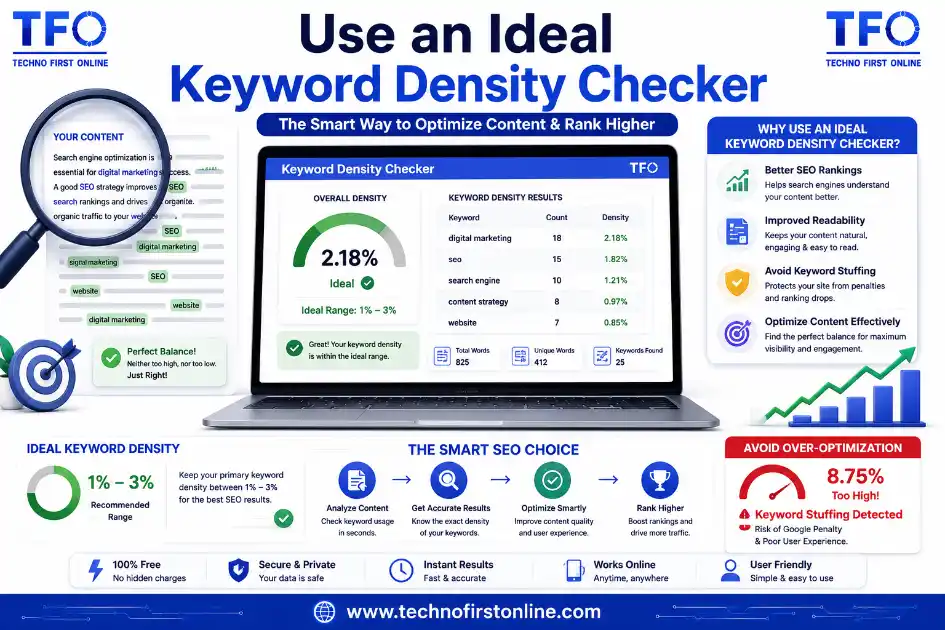
The ideal keyword density for SEO generally falls between 0.5% and 2.5% for a primary keyword, though the exact figure depends on content length, competitiveness of the target phrase, and how naturally the term fits the writing. There’s no single percentage Google confirms as correct, so this range functions more as a sanity check than a strict rule to hit exactly.
Why There's No Single "Correct" Number
Anyone searching for the ideal keyword density hoping to find one definitive figure, like “1.2% exactly,” will end up disappointed. Search engines have never published an official target percentage, and for good reason: content varies too much in length, format, and competitiveness for a single number to make sense across every situation.
A 300-word product description and a 3,000-word comprehensive guide can’t reasonably follow the same density rule. The product page might naturally use its target phrase eight times and land around 2.5%, which reads perfectly fine at that length. The same 2.5% on the guide would require the phrase to appear roughly 75 times, which almost always sounds repetitive no matter how carefully it’s distributed.
This is why the widely cited 0.5% to 2.5% range should be treated as a general guideline that adjusts based on context, not a fixed target every piece of content needs to hit precisely.
Why This Question Keeps Coming Up
Every few years, a fresh wave of writers asks the same underlying question in slightly different words: what is the ideal keyword density that will actually move the needle for rankings? The persistence of this question makes sense. Unlike more abstract SEO concepts, density gives you something concrete and measurable, a single number you can calculate in seconds, which feels far more actionable than vaguer advice like “write high-quality content.”
The catch is that the ideal keyword density has never functioned as a ranking lever the way many writers hope. It’s closer to a diagnostic checkpoint than a control you can turn up to push rankings higher. Understanding this distinction changes how you should actually use the number once you have it.
Real-World SEO Density Benchmarks Worth Knowing
Beyond the general 0.5% to 2.5% range, it helps to see how the ideal keyword density plays out across a few concrete scenarios drawn from common content types:
A 600-word local service page targeting “emergency plumber near me” might naturally use the exact phrase 8 times, landing around 1.3%, while also naturally incorporating variations like “24-hour plumbing service” and “emergency pipe repair” throughout the remaining copy.
A 2,200-word comparison article covering two competing software products might use its primary target phrase only 12 times, around 0.5%, while spending the bulk of its word count on genuine feature comparisons, screenshots, and use cases, which is exactly the kind of content depth that naturally dilutes density without hurting relevance.
A 900-word FAQ-style page answering a single specific question might justifiably sit closer to 2%, since the narrower scope means fewer opportunities to introduce entirely unrelated supporting content.
None of these examples represents a “correct” formula to copy exactly. They illustrate how the ideal keyword density shifts naturally based on what a piece of content is actually trying to accomplish, rather than following one universal target.
Breaking Down the Ideal Range by Content Type
Different content formats tend to support different density levels naturally, based on how much room there is to work a keyword in without forcing it.
Blog posts and articles (1,500–2,500 words): Generally perform best around 0.5% to 1.5%. Longer-form content has more room to cover related subtopics, which naturally dilutes the primary keyword’s share while still demonstrating strong topical relevance through supporting terms.
Product and landing pages (200–800 words): Can comfortably sit slightly higher, often 1% to 2%, since shorter content has less room to build topical depth through variation, so the primary phrase naturally makes up a larger share of the total.
Pillar or cornerstone content (2,500+ words): Usually performs best on the lower end, around 0.5% to 1%, distributed across multiple related subtopics and headings rather than concentrated around one exact phrase repeated dozens of times.
Meta descriptions and titles: These aren’t measured the same way as body content density, but including your primary keyword once, naturally, in both remains a standard best practice regardless of body content percentage.
Ideal Keyword Density by Content Type
Different types of content naturally require different keyword density ranges. A short landing page can use the primary keyword more frequently than a long-form guide without sounding repetitive. Instead of following one fixed percentage for every page, use the table below as a practical reference to understand what works best for different content formats.
| Content Type | Recommended Keyword Density | Why It Works |
|---|---|---|
| Blog Posts (1,500–2,500 words) | 0.5%–1.5% | Longer content naturally includes related topics, reducing the need for frequent keyword repetition. |
| Product Pages (200–800 words) | 1%–2% | Shorter pages often need to mention the primary keyword more often to stay relevant. |
| Landing Pages | 1%–2% | Focused content with a single goal can support slightly higher keyword usage while remaining natural. |
| Pillar Content (2,500+ words) | 0.5%–1% | Comprehensive guides rely more on topical depth and related keywords than repeated exact-match phrases. |
| FAQ Pages | 1%–2% | Question-and-answer formats naturally repeat the target keyword while addressing common user queries. |
Important Note
These percentages should be treated as general guidelines rather than strict SEO rules. Google’s algorithms don’t recommend a specific keyword density target, so the best approach is to write naturally, prioritize user experience, and use keyword density as a way to identify potential overuse or underuse instead of chasing an exact number.
What Happens Outside the Ideal Range
Understanding both directions matters just as much as the ideal keyword density range itself.
Density too low (under 0.3%): This often signals the content doesn’t sufficiently address the target topic, or the keyword hasn’t been placed in the positions that carry the most SEO weight, such as the title, opening paragraph, and at least one subheading. It’s worth noting that low density doesn’t automatically mean bad content; sometimes a well-written piece simply covers a topic broadly enough that one exact phrase naturally appears less often, which isn’t necessarily a problem if related terms are well represented instead.
Density too high (above 3%): This is where content risks reading as forced or repetitive, and in more extreme cases, resembling keyword stuffing. Google’s own guidance on content quality emphasizes writing primarily for readers, and content that feels unnatural due to excessive repetition tends to perform worse with actual visitors regardless of any algorithmic factor, since it damages trust and readability.
How Keyword Competitiveness Affects the Ideal Percentage
A detail often missing from generic advice: how competitive your target keyword is also influences what density makes sense. Highly competitive, broad terms like “insurance” or “loans” tend to appear in extremely authoritative, well-established content that doesn’t need heavy repetition to signal relevance, since the surrounding context already makes the topic obvious. Long-tail, specific phrases like “affordable pet insurance for senior dogs” often need slightly more direct repetition simply because the phrase itself carries more of the page’s topical signal, and there are fewer natural synonyms to lean on.
This is one reason checking density using a dedicated tool before publishing is more useful than memorizing a single universal percentage. Running the actual numbers against your specific content and keyword combination gives a far more accurate read than applying a blanket rule.
Why Use an Ideal Keyword Density Checker?
Knowing the recommended keyword density range is helpful, but checking your actual content is what ensures you’re applying those recommendations effectively. An Ideal Keyword Density Checker helps you measure how frequently your primary keyword appears, making it easier to maintain a natural balance without relying on guesswork.
It can also highlight sections where keywords are repeated too often, helping you reduce the risk of keyword stuffing while improving readability and overall content quality. Since the tool runs directly in your browser, your content remains private and isn’t uploaded to external servers. Whether you’re optimizing a new article or refreshing an older page, it provides a quick and reliable way to verify that your content stays reader-friendly while following modern SEO best practices.
A Practical Framework for Finding Your Ideal Number
Rather than fixating on hitting an exact percentage, use this framework when reviewing your own content:
- Write naturally first, covering the topic with genuine depth before checking any numbers.
- Run a density check on your primary keyword once the draft is complete.
- Compare against the 0.5%–2.5% range, adjusted for your specific content length and type.
- Read flagged high-density sections aloud to confirm whether repetition feels natural or forced, since the number alone doesn’t capture tone.
- Check related terms, not just your exact primary phrase, to confirm broader topical coverage rather than reliance on one repeated term.
- Revise for readability first, treating the percentage as a secondary confirmation rather than the primary goal.
This mirrors the approach covered in our step-by-step guide to checking keyword density in an article, where the process itself matters more than any single output number.
Common Questions About “Ideal” Density in Practice
A frequent point of confusion is whether the ideal keyword density applies per page or across an entire website. It applies per page. Each piece of content should be evaluated on its own for its own target keyword, since averaging across an entire site would obscure whether any individual page is actually over- or under-optimized for the specific term it’s meant to rank for.
Another common question involves secondary keywords diluting the primary term’s density. This isn’t something to avoid; a page with a well-distributed mix of one primary keyword at a healthy density alongside several related secondary terms tends to demonstrate stronger topical authority than a page obsessively repeating one exact phrase while ignoring everything adjacent to it. If you’re unsure whether your content risks tipping too far in either direction, checking specifically for stuffing patterns alongside the standard density number catches issues a raw percentage alone might miss.

TechnoFirstOnline provides powerful free online tools, expert tutorials, and smart digital resources to simplify everyday tasks. Explore SEO, image, AI, PDF, and productivity tools designed for everyone.
Other Useful Tools



















Password Generator
Open
People Also Read


keyword density checker chrome extension

website keyword density

Best free keyword density checker tools
keyword density analyzer

Keyword Stuffing Checker

Keyword Density Calculator

How to Check Keyword Density

Word Density Checker vs Keyword Density Checker

What Is a Password Hash Generator

SHA-1 vs SHA-256 vs SHA-512 comparison

what is bcrypt beginners guide

md5 vs sha256 vs bcrypt

Is MD5 Still Secure Hash Collisions Explained

How Generate Hash Online

MD5 Hash Generator Online guide

How to Create a Custom QR Code for Free



stylish text generator

How to change to sentence case online
How to Automatically Change Capital Letters to Lowercase

Grammarly Word Count vs Free Word Counter

word counter google docs — How to Check Word Count

Word Count Checker — Check Word Count in PDFs & Documents
Free Character Counter Online — Count Letters & Spaces

How to Word Counter Online Free

NTLM Hsah vs MD5 vs SHA

decrypt md5 hash

password salting explained

php password hash guide
What Is a Password Hash Generator
SHA-1 vs SHA-256 vs SHA-512 comparison
what is bcrypt beginners guide
md5 vs sha256 vs bcrypt
Is MD5 Still Secure Hash Collisions Explained
How Generate Hash Online
MD5 Hash Generator Online guide

WiFi QR Code Generator

LastPass vs Norton vs Bitwarden

Password Manager Pros & Cons

16 Character Password Generator

What Makes a Password Strong

Different Password for Every Website

Common Password Mistakes

Random Password Generator vs Manual Passwords

Strong Password Examples
Optimizing written content is only one part of creating a well-optimized webpage. Large, uncompressed images can slow down loading times and affect the overall user experience. Before publishing your article, you can use our Resize Image Tool to adjust image dimensions while maintaining good visual quality, helping your pages load faster and supporting better overall SEO performance.
If you're working with SEO reports, content audits, or multiple PDF documents, keeping everything organized can save time during review and collaboration. Our Merge PDF Tool lets you combine several PDF files into a single document, making it easier to manage keyword research reports, content checklists, or client documents in one convenient file.
Frequently Asked Questions
Most SEO practitioners recommend a primary keyword density between 0.5% and 2.5%, though the ideal number shifts based on content length, format, and how competitive the target phrase is.
Not directly in the way it once did. Modern algorithms weigh relevance, user intent, and natural writing quality far more heavily, though extreme over-repetition can still be flagged as a spam signal.
Not necessarily. Density that’s too low can signal the content doesn’t sufficiently cover the target topic, so both extremes carry their own risks rather than one being universally safer.
Yes. Shorter content like product pages can comfortably sit slightly higher, often 1% to 2%, while longer pillar content generally performs better distributed across a lower percentage, closer to 0.5% to 1%.
Secondary keywords are typically measured separately from your primary target, though a healthy mix of both contributes to stronger overall topical relevance rather than diluting your primary keyword’s effectiveness.
Write naturally first, then run your finished content through a density check, comparing the result against the general 0.5% to 2.5% range while adjusting for your content’s length and how competitive your target phrase is.